There was no ready PMM system. I had to build positioning, launch rhythm, and sales material while the business kept moving.
I made Pidge easier to understand and sell.
Pidge was a last-mile logistics platform. It helped businesses manage orders, partners, routes, tracking, costs, and service levels. I joined as Pidge's first product marketer (PMM) and turned that complexity into sales-ready stories.
1stPMM
5products launched
7buyer narratives
Category pressure
I walked into a product sales needed to explain.
The product was useful, but the story was hard to enter. Sales needed to explain what Pidge did, which buyers it helped, and why those buyers should care.
I was new to logistics, so I learned the product fast: orders, partners, service levels, routes, costs, and objections.
Sales needed a simple way to explain Pidge to different buyers: restaurants, ecommerce teams, direct-to-consumer brands, SMBs, and partners.
Product study
I learned the product before I rewrote the story.
I studied customer workflows, sales objections, competitor claims, and product priorities so the pitch came from reality, not guesswork.
Customer usage
How teams handled orders, partners, costs, service levels, and fulfillment before Pidge.
Product capability
Which flows made partner assignment, tracking, delivery decisions, and delivery visibility easier.
Competitor context
How Pidge differed from delivery providers, aggregators, and manual operations.
Sales reality
Which objections blocked deals, what proof helped, and where sales needed clearer material.
Clearer story
I moved the story from features to control.
Instead of opening with route planning, partner assignment, and tracking, I framed Pidge as one layer for choosing partners and controlling delivery performance.
route planningpartner selectiontrackingservice levels
buyer problemsegment storysales proof
PMM system
I built the product marketing system sales needed.
That meant website copy, help-center education, launch assets, sales decks, demos, training, and deal support.
Website copy
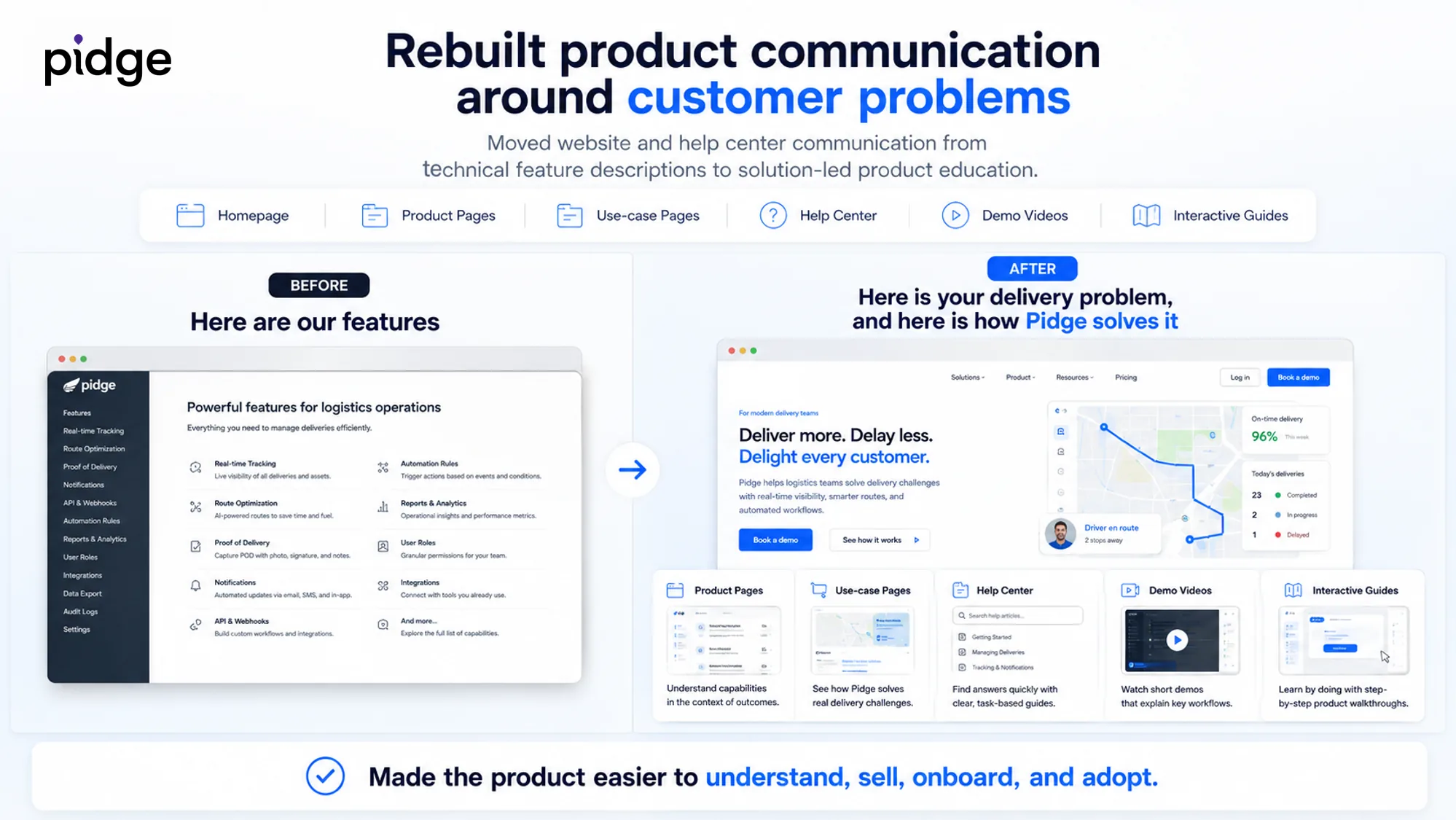
I rewrote the story around delivery problems buyers already recognized.
Help center
I turned product flows into guides, demos, and self-serve explanations.
Launch assets
I created positioning, one-pagers, demos, and sales material so launches had a clear path.
Sales support
I helped teams map each prospect's delivery problem to the right pitch, proof, and demo.
Segment pitch builder
I did not force every buyer into the same pitch.
The product stayed consistent. The starting point changed by buyer: restaurants, ecommerce teams, direct-to-consumer brands, retailers, and partners were solving different delivery problems.
Late orders quickly become lost trust.
I led with rush-hour reliability, speed, and fewer failed deliveries.
Proof focus: speed, coverage, customer experience.Build sequence
What the work became.
The work turned into six useful systems: product marketing foundation, positioning, segment stories, website education, launch rhythm, and growth support.
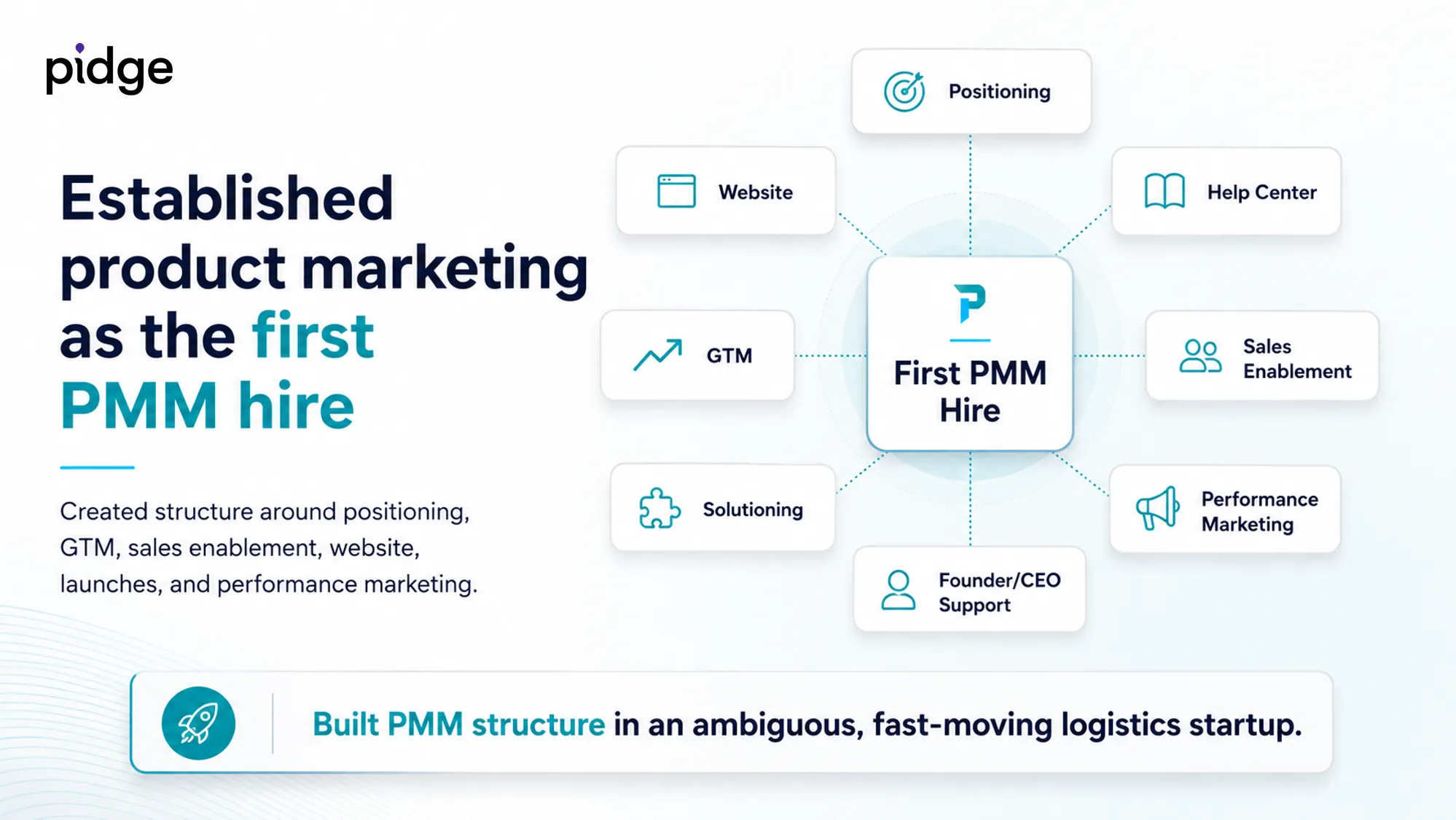
Product marketing foundation
I built the first PMM system: positioning, launch priorities, website copy, product education, and sales readiness.
product marketing structurego-to-market prioritiessales readiness
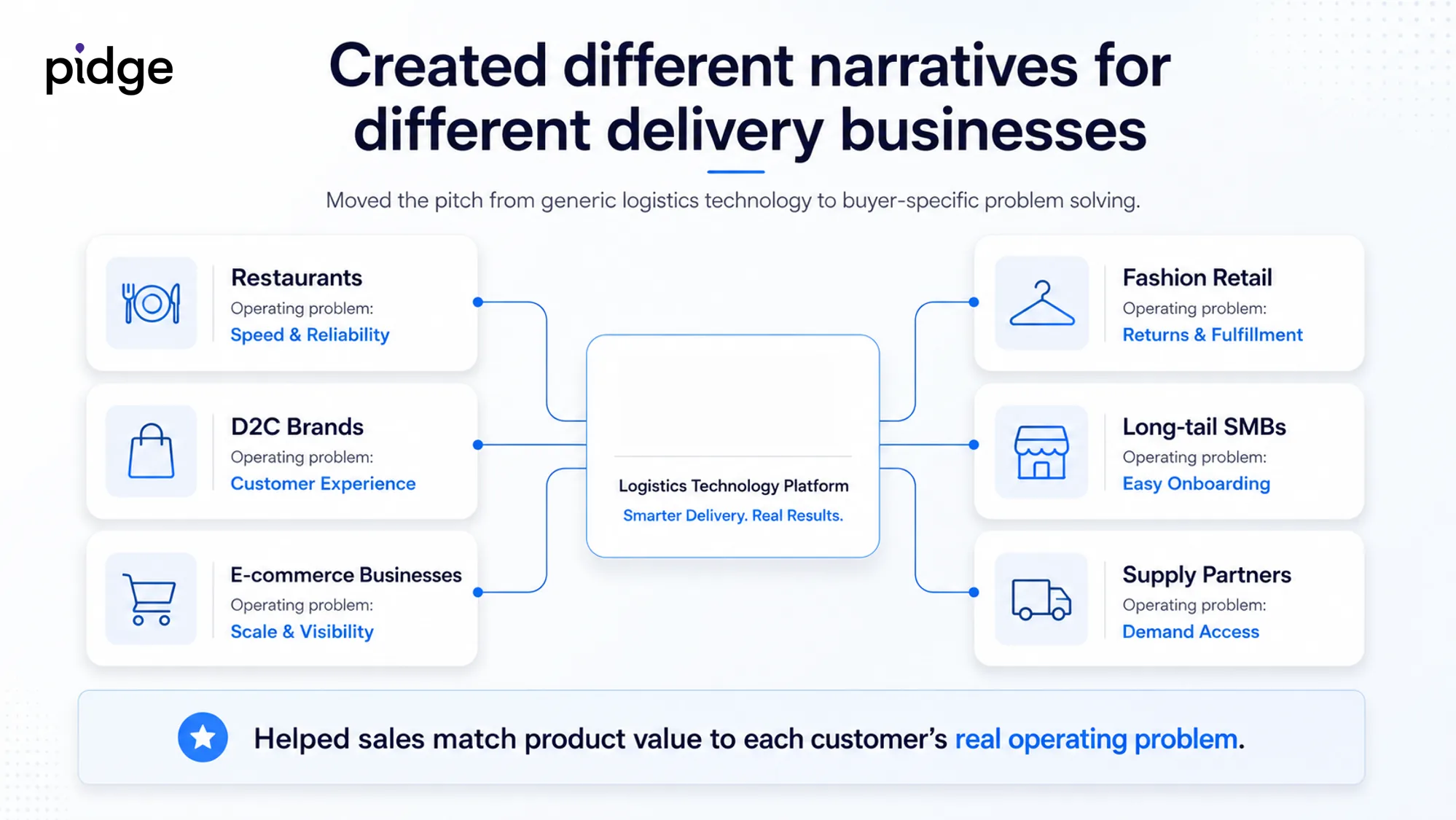
Delivery control positioning
I moved the story from delivery features to one layer for coordinating delivery partners.
delivery coordinationpartner choicesdelivery control
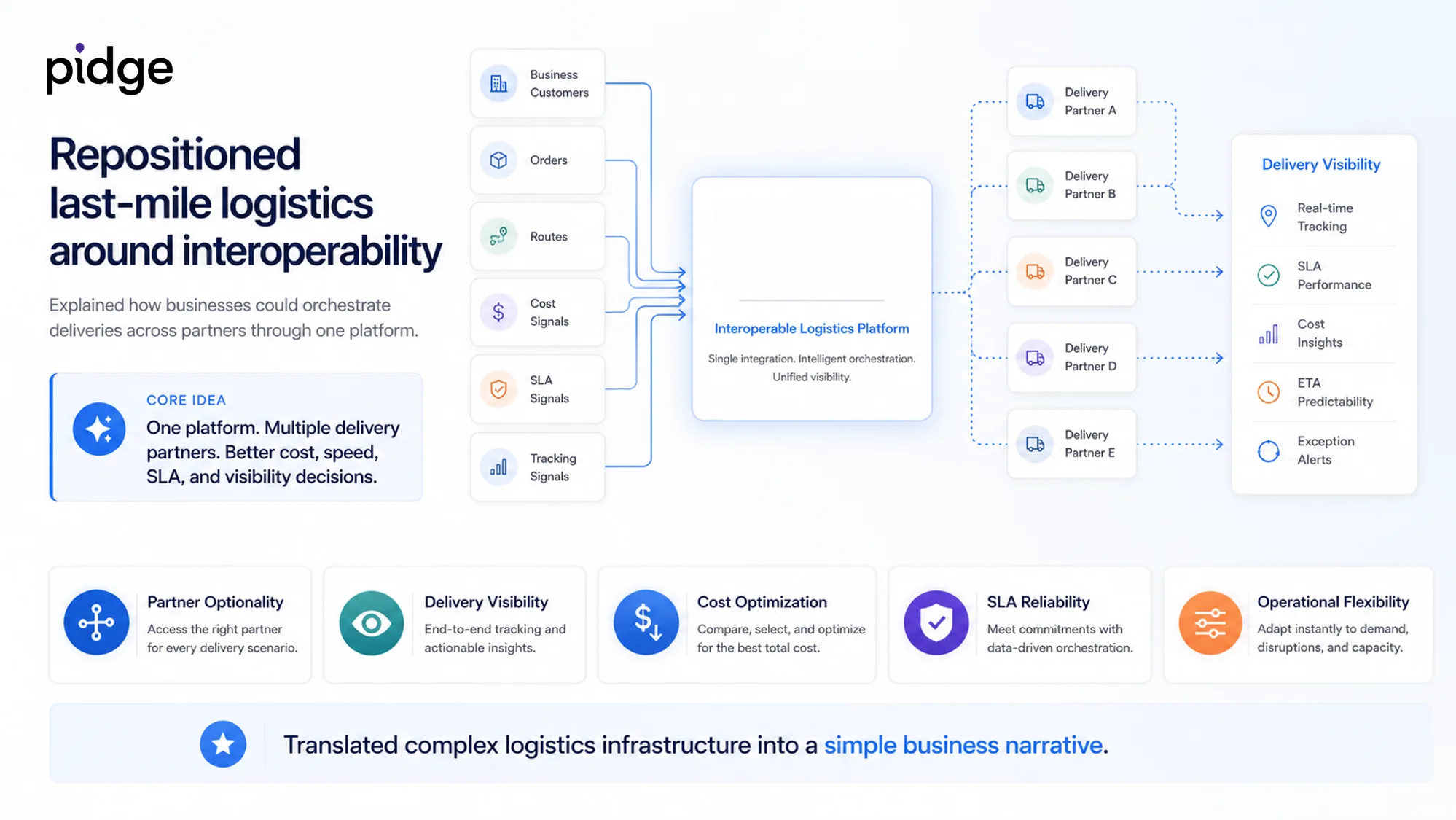
Segment sales narratives
The same product became easier to sell when each buyer had a clear reason to care.
custom pitchescategory deckstalk tracks
Website and help center rebuild
I made the website and help center explain buyer problems, product flows, demos, and self-serve learning.
solution pagesguidesdemo content
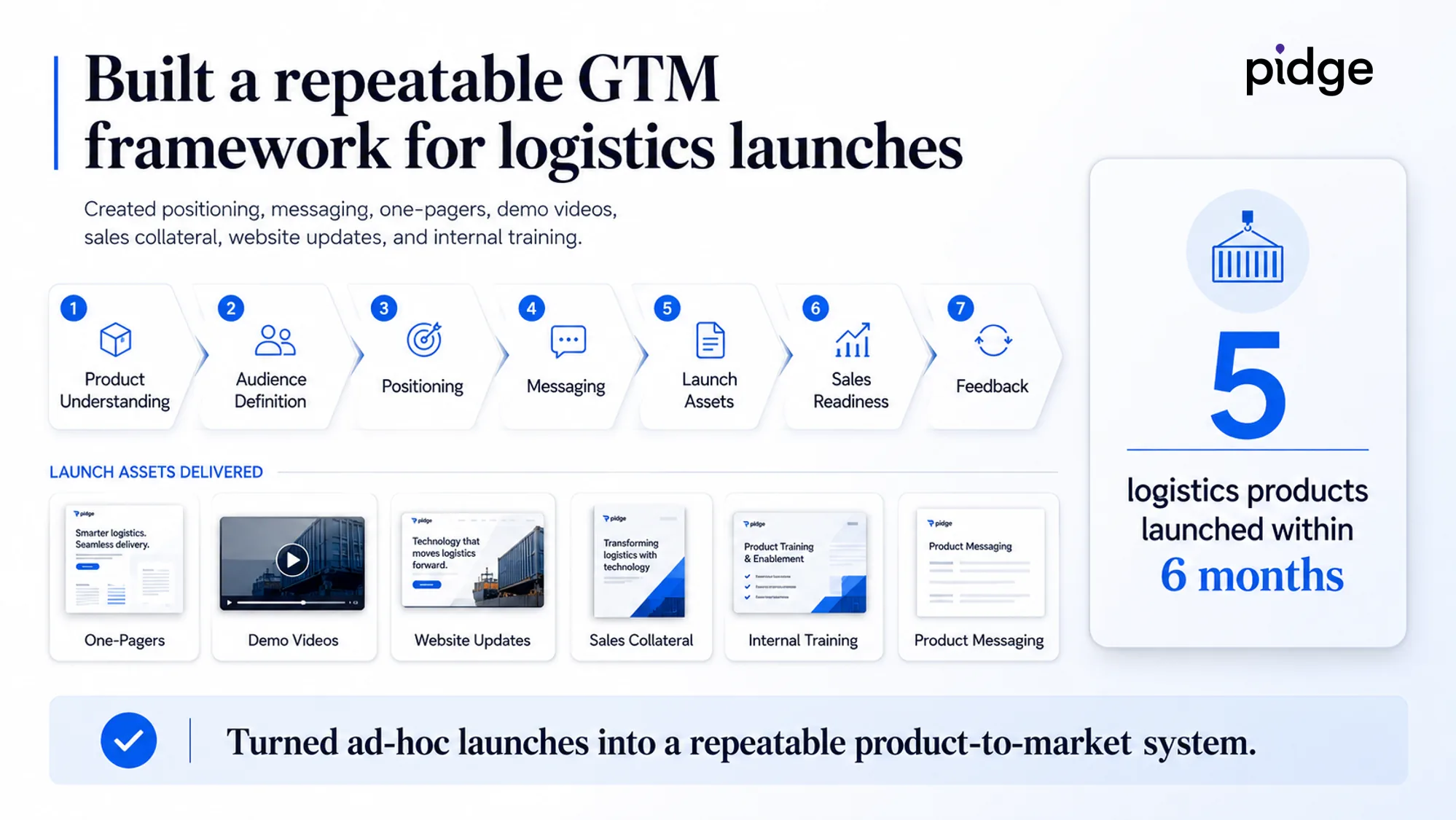
Repeatable launch system
Launches became easier to repeat because sales knew what changed, who it helped, and why it mattered.
launch frameworklaunch assetstraining
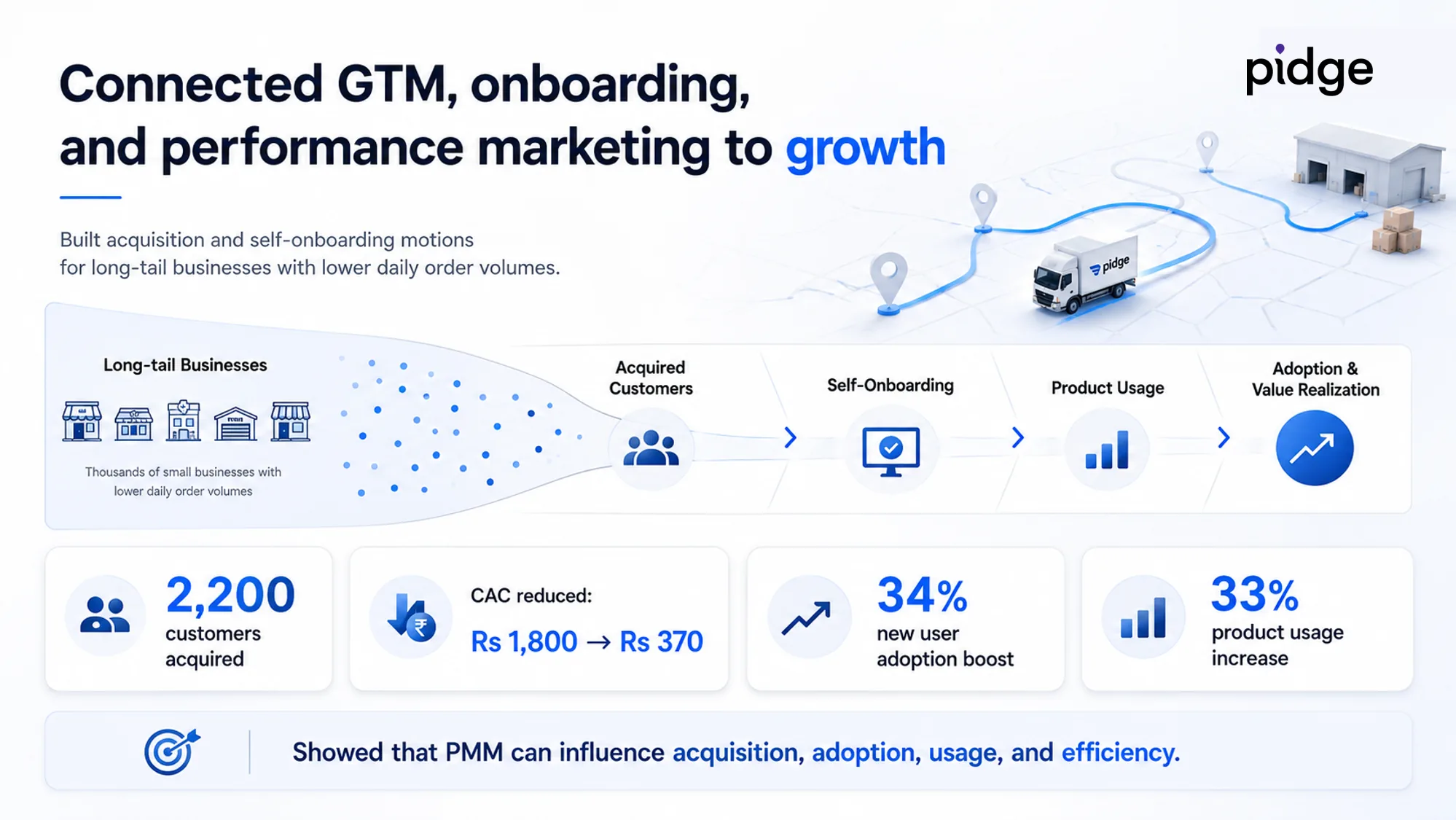
Acquisition, onboarding, and usage
I connected the product story to acquisition, onboarding, nurture, and product usage.
2,200 customerslower acquisition costusage lift
Commercial movement
The work showed up in growth numbers.
This was not just cleaner copy. The product marketing system supported launches, acquisition, onboarding, lower customer acquisition cost, adoption, and product usage.
01 / Launch output
5logistics products launched in six months
02 / Customer growth
2,200customers acquired through GTM and performance marketing
03 / Lower cost
Rs 1,800toRs 370customer acquisition cost reduction
04 / Onboarding
34%new user adoption boost through self-onboarding
05 / Usage growth
33%usage growth through nurturing campaigns
Keep exploring
Pidge taught me how to become useful in last-mile logistics.
I did not enter logistics as an expert. I became useful by learning the product, cutting through the complexity, and giving sales a clearer story. That pattern carried forward into larger, messier product systems.
I made Pidge easierto explain and sell.
Pidge helped businesses manage last-mile delivery across orders, partners, routes, tracking, costs, and service levels. I joined as Pidge's first product marketer (PMM) and turned that complexity into sales-ready stories, launch assets, and buyer-specific pitches.
I built the product marketing system while sales was already moving.
I gave different buyer groups their own reason to care.
I helped make product launches repeatable and sales-ready.
Buyer storySame product. Different buyer problems.
Restaurants, ecommerce teams, direct-to-consumer brands, and small businesses cared about different delivery problems. The product stayed the same. The pitch had to change.
01
Restaurants cared about delivery reliability.
02
Ecommerce cared about cost, coverage, and tracking.
03
Direct-to-consumer brands cared about customer trust.
04
Small businesses cared about scaling without a logistics team.
Why it was hard
The product had depth.Sales needed an entry point.
No product marketing system existed yet
Positioning, launches, website clarity, enablement, and sales support had to be built while the business kept moving.
Too many things to explain
Routes, partners, service levels, costs, tracking, and exceptions all mattered. But if every detail led the story, sales had no clean starting point.
Different buyer worries
Restaurants worried about late orders. Ecommerce teams worried about margin. Direct-to-consumer brands worried about trust. Small businesses wanted less operational load.
Before
We were explaining everything at once.
The product had real depth, but the story opened with too many operational details.RoutesPartnersService levelsCostsTrackingExceptionsPartner selection
My cut
Start with control.Pidge helps teams choose delivery partners without losing visibility, reliability, or cost control.After
Start with the buyer's problem.
Segment narratives
Same product. Four buyer problems.The pitch had to change.
Restaurants
For restaurants, late delivery was a customer experience problem. It hurt repeat orders and rush-hour trust.
Pitch angleReliable delivery without building a delivery operation.
Ecommerce
For ecommerce teams, delivery affected cost, coverage, tracking, and customer confidence at the same time.
Pitch angleControl cost, speed, coverage, and reliability.
Direct-to-consumer brands
For direct-to-consumer brands, delivery was part of the brand experience. Customers may never see the logistics layer, but they feel the result.
Pitch angleProtect the customer experience while scaling delivery.
Small businesses
For small businesses, logistics got heavy quickly. Most did not have a dedicated operations team to manage delivery.
Pitch angleScale delivery without building a logistics team.
I stopped making one pitch do every job.
The product stayed the same. The first problem we led with changed.
Different buyer stories. Same product underneath.
That made the first conversation easier without shrinking the product.
PMM system built
I built the PMM system.Then I made it usable.
Checkpoint / Product marketing foundation
Product marketing became visible.Sales had a clearer system.
There was no finished product marketing system. I built the structure around positioning, sales enablement, help-center education, website clarity, and launches.
- I made the product marketing work visible.
- I connected positioning, sales support, education, website work, and launches.
- I gave the team a clearer way to see what product marketing was doing.
Checkpoint / Delivery control positioning
The story moved to control.Not every feature at once.
Instead of explaining every feature, I brought the story back to control: choose partners, keep visibility, protect reliability.
- I moved the story away from delivery logic alone.
- I made the product simpler to understand without flattening it.
- I gave sales a cleaner way to explain why it mattered.
Checkpoint / Repeatable launch system
Launches got a repeatable path.Sales knew what changed.
Positioning, messaging, one-pagers, demo videos, website updates, sales collateral, and training moved together.
- I supported five product launches in six months.
- I built assets sales could actually use.
- I made sales readiness part of the process.
Launch system
I made launches repeatable.So we were not starting from zero.
Understand the product
I first had to understand what Pidge really did for businesses and delivery partners.
Define the audience
Then I chose which buyer problem should lead each story.
Set positioning
I turned the product into a clear promise sales could repeat.
Sharpen messaging
I cut technical language into clear claims.
Build launch assets
I created one-pagers, demos, sales collateral, and website updates.
Ready sales
I gave sales the story, proof, and answers they needed for buyer conversations.
Close the loop
I used objections and feedback to improve the next launch.
Commercial proof
The story became easier to sell.The launches became easier to repeat.
I turned last-mile logistics into something the team could use.
The proof is in the shift: Pidge became easier to explain, launch, and sell without losing the product depth.
- I learned a dense logistics category quickly.
- I connected positioning, buyer stories, product education, launches, and sales support.
- I made product depth easier for sales teams to use.
logistics products launched within six months
Each launch had story, assets, and sales readiness moving together.
customers acquired through performance marketing and go-to-market work
Performance marketing worked better when journeys and messaging were clearer.
customer acquisition cost reduction
The work helped reduce acquisition cost, not just increase spend.
new user adoption boost in three months through self-onboarding
Clearer onboarding helped more users get started without handholding.
product usage growth through nurturing campaigns
Nurture campaigns gave users clearer reasons to return and use the product.
Bridge to the next chapter
Pidge taught me how to become useful in last-mile logistics.
I did not enter logistics as an expert. I became useful by learning the product, cutting through the complexity, and giving sales a clearer story.
That is the real proof here: I can enter a messy market, learn the product fast, and make the story useful for the people who have to sell it.
The useful pattern stayed the same: learn the product, find the clearest story, and make it usable.