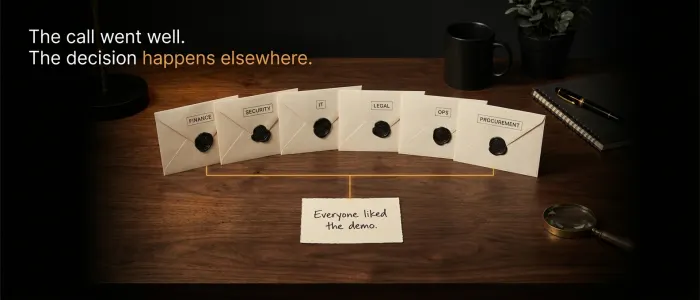
When a deal stalls after a demo everyone liked, the standard prescription is a persona pack -- one document per stakeholder, each page tuned to the person reading it. Gartner's data says that prescription makes the stall worse. This article is about the smaller move that works: an afternoon spent reading your own stalled deals to find the two people on the buying side who keep blocking each other, then building the one document that lets them agree.
I run product marketing alone, across a portfolio of seventeen products, so every stalled deal eventually reaches me as a request for more content. I have answered that request with tailored pages more than once. The evidence below says the tailoring was making things worse.
Buying group consensus is the agreement a committee of buyers has to build among themselves, in meetings the vendor never attends, before a purchase can move. From the selling side, its absence looks like nothing. A champion writes on Thursday that everyone liked the demo and she is taking it to the wider team. A fortnight passes, the deal slides to next quarter, and nobody ever says no. I have read that Thursday message and felt fine about it, because nothing on the call was wrong. The break happened later, in a room I was not in.
One page per seat sounds thorough
The persona pack instinct is easy to defend. The committee has a finance seat, a security seat, an IT seat, an ops seat, and a legal seat, so write each seat a page in its own language. Every chair gets a document built for that chair, and the work looks complete.
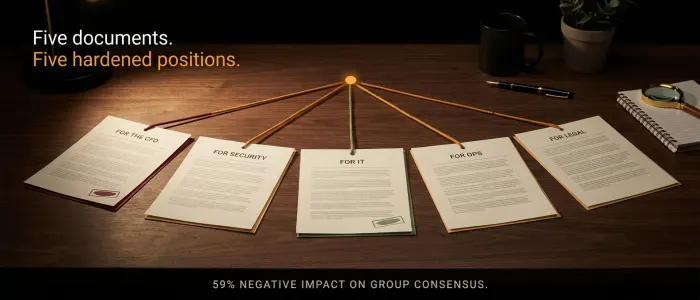
Gartner surveyed 632 B2B buyers and measured the opposite effect. Content built for individual-level relevance carried a 59% negative impact on buying group consensus, while content built for the buying group or the wider organisation moved consensus the other way, by 20%. Gartner, May 2025 Gartner does not publish the base those percentages are measured against, so read them as direction and size rather than as exact rates.
The mechanism Gartner names is confirmation bias. A page written for the CFO tells the CFO what she already suspected, so she walks into the meeting more certain than she left the demo. The security lead gets a different page and a different certainty. Five tailored documents produce five hardened positions, and one meeting has to reconcile them.
The room disagrees before you arrive
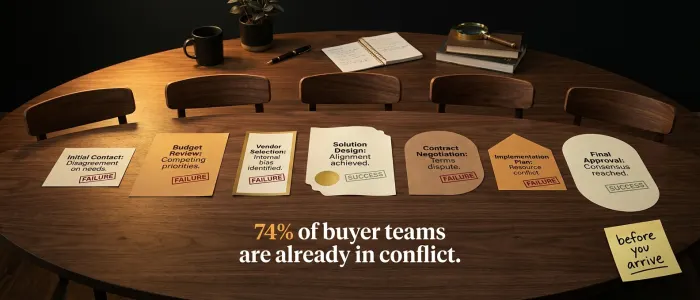
The same survey found that 74% of B2B buyer teams show what Gartner calls unhealthy conflict during the decision: members hold conflicting objectives, disagree on the right course, or get overruled by someone outside the group. That is the normal room, not the bad case. Gartner's current published figure puts buying groups at five to 16 people, across as many as four functions, and most of those people do not report to each other.
The prize for settling the argument is real too. Groups that do reach consensus are 2.5 times more likely to report the deal was high quality. Gartner, May 2025 So the deal turns on agreement among people the seller never meets, inside a group that usually arrives already divided.
The stall sits after the choice, not before it
When a committee deal goes quiet, the product marketing instinct is to reach for the messaging, because messaging is the part we control. Sometimes that is right: a message that cannot be repeated accurately falls apart in transit, and that is worth testing directly. The committee problem sits one step later. The message arrives intact, and the room still cannot move, because the people in it want different outcomes from the same purchase. Another headline does nothing to a structural disagreement, and a headline aimed at one person makes it slightly worse.
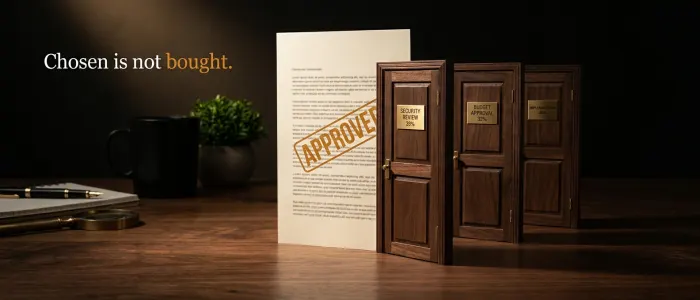
G2's 2026 buyer behaviour research, a survey of more than 1,000 B2B software buyers, asked what delays deals after a vendor has been chosen. IT security review came first, named by 39% of buyers overall and 50% at enterprise. Budget approval followed at 32%, implementation planning at 25%. G2, July 2026 The same research tracked finance involvement in software decisions rising from 31% to 46% in a single year, and nearly half of buyers said their CFO vetoed an already-approved deal in the last twelve months. Being chosen is not the end of the sale. It is the moment the champion starts carrying the deal through approval gates the vendor cannot attend.
Most of what dies in those gates dies quietly. Matthew Dixon and Ted McKenna studied more than 2.5 million recorded sales conversations and found that between 40% and 60% of deals end with a customer who states an intent to buy and then fails to act. Harvard Business Review, June 2022 Not lost to a competitor. Lost to a room that could not settle.
Read ten deals and name the fight
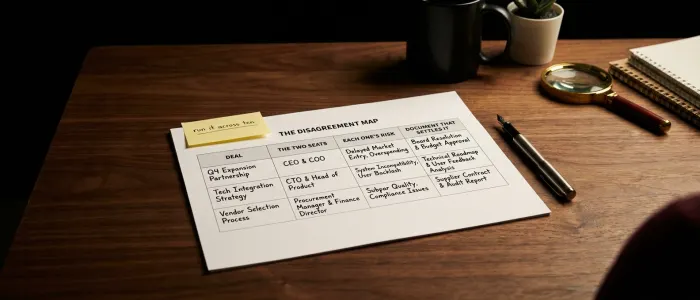
The alternative to the persona pack is a disagreement map: a record of who blocked whom on your last ten stalled deals, built from notes you already have. It takes an afternoon. Here is the procedure, with the reason each step exists.
- Pull the last ten deals that stalled after a good first call. Ten is enough to show a pattern and small enough to finish in one sitting.
- For each deal, name the two people on the buying side who wanted different things -- the actual humans, by seat, not roles in the abstract. Abstraction is what the persona pack ran on, and abstraction is what hid the problem.
- Write down each person's version of the risk, in the words they used, taken from call notes or the rep's recollection. Their words matter because the document you build later has to answer both versions at once.
- Name the single document that would let those two settle it without another meeting, and mark whether it exists today. This step turns the map into a build list instead of a complaint.
- Count how often the same pair repeats. The repeated pair is the finding.
Three pairs are worth expecting, because they match the three gates G2 measured: security against the business owner, finance against the champion, and IT against the person who has to use the thing. I am not certain the pair is always two people -- sometimes it looks like one person against a vague institutional caution -- but that has not changed what I would build. If one pair surfaces more than once, it points at one document, usually a document nobody in marketing currently owns. If no pair repeats, the stall is not a committee problem, and the map has told you that too, for the price of an afternoon.
The notes will fight this. Most CRM records say the deal went quiet, not who disagreed with whom, so the first run leans on what the reps remember rather than what was typed. The fix is one field on the stalled-deal form -- who on their side did not agree -- and that one field makes every later run cheaper than the first.
One document, written for the organisation
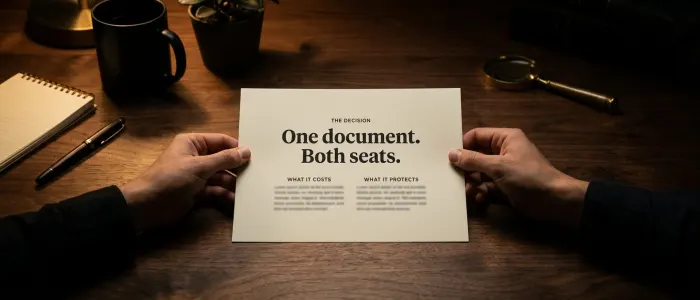
What you build for the repeated pair is a single document both seats can read and reach the same conclusion from. Written for the organisation rather than for either reader -- that is the Gartner finding turned into an instruction. It describes a shared decision with the trade-off visible, instead of reassuring each reader separately.
For security against the business owner, that is usually one review packet: what data moves where, what the controls are, what the rollout looks like, and what it costs to say no. In regulated markets that packet stops being a sales asset and becomes the evaluation itself. For finance against the champion, it is the arithmetic with the assumptions exposed, including the ones that weaken the case. Exposing the weak assumption feels like a mistake, and it is the point: it lets a sceptic forward the document without staking their own credibility on it. For IT against the eventual user, it is the rollout -- who administers it, what breaks in the first month, and who picks up the phone when it does.
The champion already said yes, so she does not need persuading. She needs to survive a meeting, and a document that survives meetings is a different artifact from a document that persuades.
When the pack has already been promised
Usually this arrives too late. Someone senior has already asked for a one-pager per stakeholder, and a refusal reads as product marketing being difficult about work it does not fancy. So do not refuse. Agree the date, then change what lands on it. The first deliverable becomes one page listing which two seats disagreed on the last ten stalled deals, and the persona pages follow that page rather than replacing it.
Almost nobody argues with that, because it costs a day and it answers a question the requester also wants answered. If the map shows one pair repeating, five pages quietly become one and nobody loses face. If the map shows nothing, build the pages -- at least then the persona pack is a decision rather than a reflex. Asking permission to investigate is slower than investigating: a day of reading becomes a proposal, and proposals need a meeting.
Numbers for before, signals for after
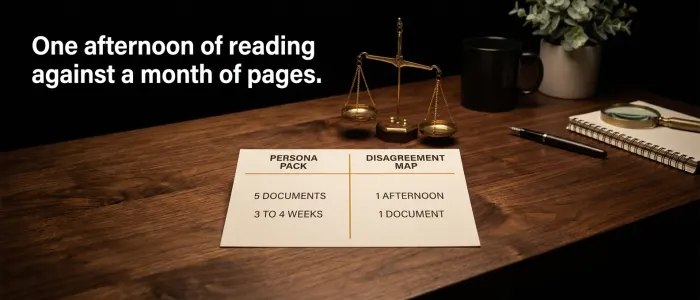
Before the planning meeting, turn the stall into money, because the method on its own persuades nobody. Ten deals sitting in post-selection limbo at an average of, say, forty thousand is four hundred thousand waiting behind one document and one afternoon of reading. Put that figure on the slide, not the map. For comparison, a persona pack costs five documents, review cycles and design time -- three to four weeks of a marketer's quarter -- and its larger cost is larger than it looks, because the actual blocker sits untouched while the pages get designed.
Afterwards, watch two signals. The quiet one is that the champion forwards the document and never asks for a call to walk anyone through it. The countable one is days from the champion's yes to signature. Compare the deals closed after the document existed with the ones before it. That is a number a revenue leader already tracks, so nobody has to be talked into it.
The afternoon before the quarter
If your deals keep reaching a yes from the champion and then stopping, and nobody can name who is blocking them, spend the afternoon before you spend the quarter. If someone on the team can already name the blocking pair and is right, skip the map and build the document. And if the request that started all this arrived as a one-pager for each stakeholder, the asset planning worksheet is the earlier check on whether those pages should exist at all -- most requests that reach product marketing are that kind.
The deal is decided in a negotiation that happens without you. What moves it is one document that lets two people who disagree arrive at the same place. A message can convince every person in the room individually and still leave the room stuck. Build for the room.