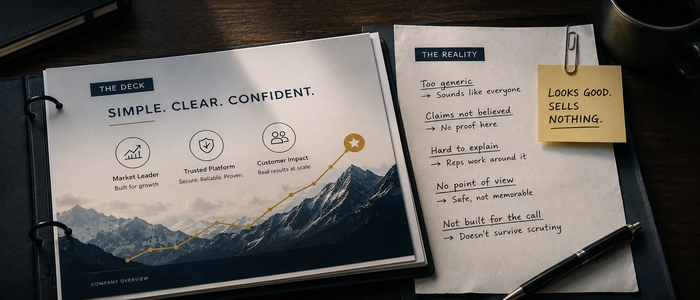
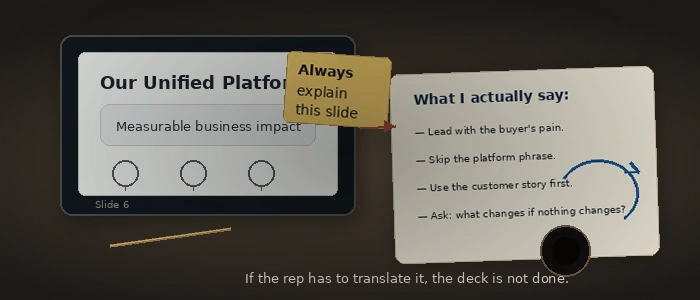
The deck is beautiful. Legal has approved it. Brand has blessed it. Leadership has seen it. The file name now has a date, a version number, and mild emotional damage. Then the sales rep reaches slide six and starts explaining around it.
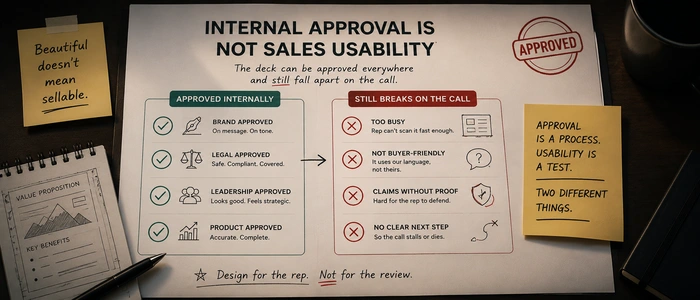
That moment tells you everything a formal deck review would, and it costs nothing to watch. A sales deck is done when two things are true: an average seller can run it in a live conversation without translating it, and the buyer can retell the value afterwards, with nobody from your company in the room. Approval measures neither. Approval measures whether the company is comfortable, and comfort is a different property from usefulness.
I have shipped decks that failed both halves of that test. At CredFlow my job was simplifying fintech messaging until SMB sales teams could say it naturally, and at Pidge I built decks inside a GTM system where solution selling lived or died on what a seller could actually say under pressure. Watching a rep use your own slides is a humbling hobby, and everything below comes from it.
How a deck goes bad politely
Most sales decks are not born bad. They become bad through a mechanism that looks like teamwork. Product wants accuracy, so qualifiers appear. Marketing wants a sharper story, so a headline gets ambitious. Legal wants risk removed, so the claims soften. Brand wants consistency, so the buyer's language gets replaced with the company's. Leadership wants ambition, so a vision slide lands at the front. Every function protected its concern, and the buyer's decision was nobody's concern in particular. The result is a document that records what the company could agree on rather than a tool that helps a stranger decide. A lot of sales decks are not sales tools. They are internal compromises exported to PDF.
That sounds harsh until you watch sellers work. They skip slides. They rewrite headings out loud. They say, "What this really means is..." and then explain the point in normal language. That sentence is a rescue: the rep is supplying, live, the meaning the slide was supposed to carry on its own. A rescued deck is borrowing credibility from the rep and paying none back. The rep is not lazy. The rep is surviving.
The deck has one job: remove the buyer's next confusion
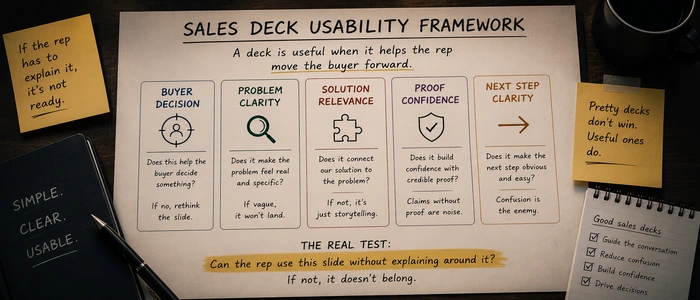
A slide earns its place when it resolves a specific confusion the buyer actually has at that point in the conversation -- what problem this addresses, how it differs from what they own, what changes in the first month, why they should believe the claim. A slide that resolves no confusion is decoration, whatever it cost.
The commercial stakes on this have been measured. Gartner reported in 2025 that 61% of surveyed B2B buyers preferred a rep-free buying experience, and its 2026 survey put the figure at 67%. Gartner 2025 Gartner 2026 Stated preferences run ahead of actual behaviour, but the direction is blunt: most buyers will only tolerate a seller who adds clarity. The deck is the seller's clarity instrument. If it adds none, the seller has nothing to add either, and the buyer was right to prefer the website.
And the person on the call is rarely the last audience. They retell the story to finance, procurement, IT, a department head, a sceptical operator who shows up only when risk appears. The deck they saw becomes the raw material for that retelling, which makes it the first draft of the internal business case. A deck that works only while your seller narrates it dies in the second meeting -- the one your seller never attends.
Pretty slides fail in ugly moments
Sales conversations are not clean. Buyers interrupt, ask questions out of order, and carry baggage from a bad implementation three years ago. They care about one workflow detail you buried in the appendix. Beautiful decks fail here because they are designed for the ideal path, and no real conversation follows the ideal path. The buyer asks "how is this different from what we already have?" on slide four, the answer lives on slide fourteen, and the polish starts working against the rep. A deck built for ugly moments plans for exactly this: the answer to the predictable hard question sits within one slide of where the question tends to arrive, not in an appendix ordered by product line.
Then come the "also" slides. Also we do this. Also we support that. Also here is a capability nobody asked about. Each one raises the cost of finding the slide that matters, until the deck stops being an argument and becomes an exhibition of everything the company has ever built. "Also" is how decks become museums. The buyer does not need a museum. The buyer needs help making a decision.
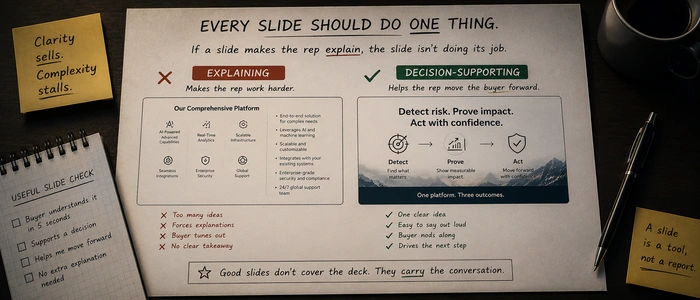
The structural fix is to order the deck by the buyer's decision instead of the company's org chart. A buyer's mind moves through pressure, change, risk, proof, objection, next step -- never through "platform overview, module one, module two." Building that order is editorial work, and it belongs to product marketing. Cut the slide that makes the company feel smart but helps nobody decide. Move proof next to the claim it supports, because proof three slides later reads as a different topic, and by then the doubt has already settled in. Replace internal phrases with words a buyer already uses, since every internal phrase is a translation the rep will have to perform live. At Pidge this was most of what "making the deck" actually meant; the slides were the last step, after the argument was in the buyer's order.
The Sales Usability Test
Before redesigning the deck, test the one you have -- with the people who use it, never the people who approved it. Use average reps, for a specific reason: top reps can survive weak enablement, so they tell you nothing about the deck. Average reps show you the deck itself.
Sit with two or three of them, each with a recent real call fresh in mind, and ask five questions.
- Which slides did you skip? A slide skipped by every rep is serving someone inside the company, and the reps have already run this test for you. Cut it or fix it.
- Where did you say "what this really means is"? Each translation point marks internal language on a slide. The rep's spoken version is usually the correct headline; promote it.
- Where did the buyer ask something the deck could not answer? That is a missing objection or missing proof, located at the exact moment of doubt. Build the slide the question asked for.
- What did the buyer say back at the end of the call? This is the repeat-back test applied to the deck. If the buyer echoes the category but never the value, the deck explained the product and armed nobody.
- What did your champion forward internally, and to whom? If the answer is "nothing" or "just the pricing slide," the deck is not surviving the meeting your seller never attends, and that meeting is where the deal is decided.
Five answers from two reps is one afternoon, and it locates the broken slides more precisely than any redesign workshop. It will not tell you everything -- reps misremember calls, and one bad meeting can slander a good slide, so treat any signal that appears only once with suspicion and any signal that appears twice as real. When you want the full slide-by-slide instrument -- every check defined, scoring included -- it lives in the Sales Deck Usability Checklist, built to be run without me in the room.
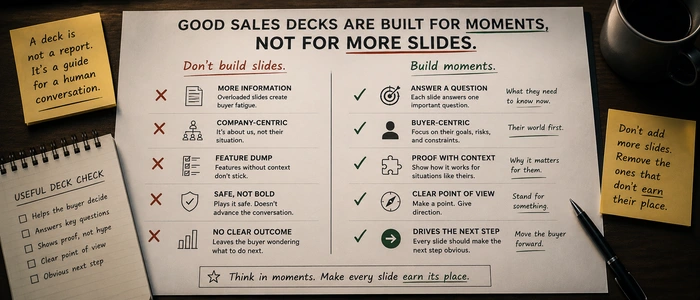
Rebuild from the call backward, not the template forward
The test output is a map of break points. Rebuild there. Keep the core story stable so the company is not reinventing its value every week, then add role depth, proof, objection handling, and implementation detail only where a real buyer's question demanded it. If the deck request itself arrived as "can you quickly make this," check what is underneath it first -- a deck is often an undecided decision wearing an asset request, and no rebuild fixes that.
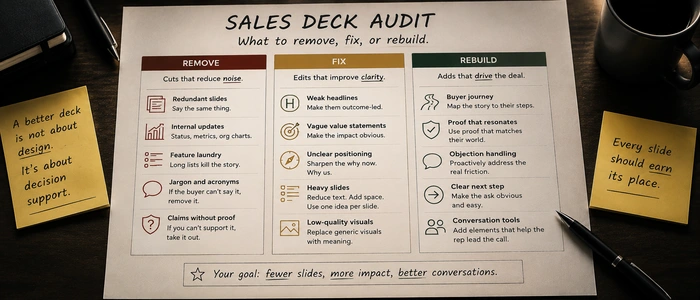
Then write the speaker notes, because they are where enablement actually lives. Bad speaker notes tell the seller what the slide says. Good speaker notes tell the seller what the slide is supposed to do. For example: use this slide to test whether the buyer recognises the problem. If they do not, do not move into the product yet. Ask where this issue shows up in their current process. Notes like that improve the seller's judgment in the moment, which is the only place judgment helps.
What done looks like
Expect the rebuilt deck to look simpler than the old one. Fewer claims, fewer adjectives, fewer diagrams, fewer slides that exist because someone once asked. Internally that can read as a downgrade. It is the opposite: useful clarity often looks less impressive than comprehensive confusion, and only one of them closes.
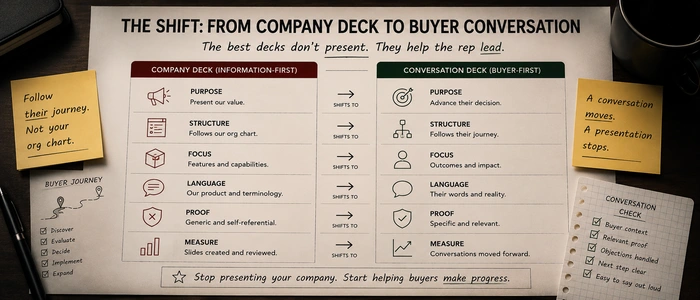
So hold the deck to the definition it started with. Not "did leadership approve it," not "did every product line get a slide," but: can an average seller run it without translating, and can the buyer retell the value into the rooms your seller never enters? If sales has to explain around it, the deck is not done.