
A rep repeats a line on a call that the company stopped using two quarters ago. Nobody corrects him. He read it that morning, on a page that is still live and still ranking.
That rep is the whole problem in one scene, and this article is about fixing it. A launch changes what a company says on the handful of surfaces in the launch plan. A surface is any place a buyer can read a claim about you: a page, a listing, a deck, a profile, a recording. Everywhere the plan does not touch, the old claim keeps travelling. The announcement turns out to be the small part of a launch; the large part is getting every surface the company speaks through to say the same thing, and no launch plan contains that work. What follows is a one-day audit that finds where the old claim still lives, and three moves for each place it turns up.
I am the only product marketer behind a seventeen-product portfolio, and for years I treated the launch date as the finish line. The plan closes, the channel goes quiet, the next thing starts. What I never checked was whether the claim the launch replaced had stopped travelling. The old claim does not stop. It sits wherever it was last written down, and most of those places are not the website.
What the launch plan leaves standing
The work that ends on launch day is the work marketing can see: announcement, page, deck, email, enablement session. Everything the company said before is still standing where it was left. An older page two clicks down. A review-site profile written when the product did one thing. A partner listing nobody has opened in a year. A recorded webinar with the old positioning on slide one. A help article describing a workflow that has since changed. A job description a recruiter wrote from a briefing that is now out of date. None of that got a date in the plan, because none of it was being launched. Nobody has measured staleness on these surfaces, so that list comes from doing the work rather than from a study.

Buyers meet both versions, and they leave over it
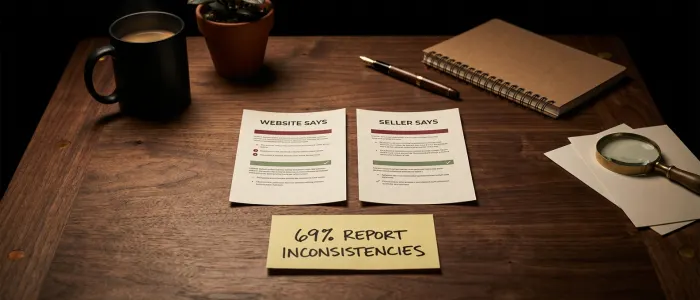
The cost of that contradiction is measured, in two places. Gartner surveyed 632 B2B buyers across August and September 2024 and found that 69% report inconsistencies between the information on a sales organisation's website and the information their sellers give them. Gartner, June 2025 That figure covers only two surfaces, the website and the rep, so it measures the narrowest version of the problem. The narrowest version is already at seven in ten.
McKinsey's 2026 pulse survey drew on close to 4,000 decision makers across thirteen countries. Buyers named inconsistent information across teams as the single biggest reason they switched suppliers this year, ranking above being unable to reach anyone knowledgeable, and the same research has buyers using an average of ten channels across a purchase. McKinsey and Company, May 2026 Switching is about accounts already won, which means stale surfaces do not stop costing you at the signature. The same contradiction that makes a prospect hesitate is what makes a customer leave, and that loss arrives without a replacement deal attached.
The damage stays quiet because nobody reports it. A buyer who finds the marketplace listing contradicting the website does not write in. They quietly trust the older description a little more. Or they walk into the first call and ask about a claim you already retired, and the rep answers as if the new claim never existed. And the confusion lands on the company rather than the product, because a vendor whose own descriptions disagree reads as a vendor still working out what it is.
Most of the reading happens before you are in the room
G2 surveyed 1,169 B2B decision makers in April 2025 and found that at companies with more than 5,000 employees, 61% named software review sites as a research source, against 50% for vendor sites. G2, 2025 Hold that one a little loosely, since G2 sells the review sites and says it used generative AI across the study, though it points the same way as everything else here. At that size, the review profile gets read more often than the website does.
Then there is when the reading happens. 6sense's 2025 study of close to 4,000 buyers puts first contact with a seller at 61% of the way through the journey. The same study finds the eventual winner already on the day-one shortlist 95% of the time. 6sense, 2025 Day one does not decide the winner, but the reading that puts a vendor on that list happens before anyone from the company can shape it, on exactly the surfaces nobody is staffing.

The old story has no owner
The reason this survives every launch is structural rather than careless. The website belongs to marketing. The help centre belongs to support or product. The review profile belongs to whoever set it up, often a demand generation person who has since left. Partner listings belong to partnerships, job descriptions to recruiting, sales decks to sales, and the copy on a rep's laptop belongs to that rep -- a deck that looks expensive carrying last year's claim is worse than a plain one carrying this year's. The old story spans all of those owners. Nothing in the launch plan does.
The audit: search for the sentence
The fix is deliberately narrower than a content inventory, because a content inventory is what people reach for instead, and it never gets finished. This audit chases one sentence.
- Write the single claim the launch changed, twice: old version and new version, side by side, in the words each actually used. It is usually one sentence. If it takes a paragraph, the launch either did several things at once or the change has not been named yet, and a claim nobody can name is usually a claim nobody can repeat back either.
- Take three or four distinctive words from the old version, the ones a competitor would not also use. Distinctive words are what make search return the claim instead of the topic.
- Run those words against the company's own domain in a search engine, then the review sites, then the marketplace and partner directories, then the shared drive where the decks live. Search rather than browse, because browsing finds what you remember and the problem is the pages you forgot.
- For every hit, write down the surface, who can edit it, and how long an edit takes. The owner column is the real output, because the next step is organised by it.
One page, most of a day. Expect two surprises. Most of the list sits outside the website, because the pages marketing controls were in the plan and got updated. And the worst offenders are old and well ranked: a page from three years ago has had three years to accumulate links, and it can sit above the new page for the exact search a buyer runs. I am not certain how many years back is worth chasing, and I have stopped assuming a cut-off, because fixing the new page does nothing about an old one that outranks it.

Edit it, date it, or ask for it
Every surface on the list takes one of three moves.
Edit it, when it is owned and quick. Much of the list is this, and fifteen minutes a surface is a fair estimate.
Date it, when it is a record rather than a claim. A webinar recording from two years ago is not wrong, it is old, and a line at the top saying so turns a contradiction into history. Deleting it is usually worse, because the old thing is often the thing ranking.
Ask for it, when it belongs to someone else. Partner listings, review profiles and analyst descriptions need a request, a person and a wait, so those go on the list with a name against them. Sometimes there is no name. A review profile set up by somebody who has since left is the common case, and recovering the account usually runs through whoever holds the vendor relationship or pays the invoice rather than through marketing. That is a support ticket and a week, so it starts on day one of the audit rather than at the end.
At some point someone senior proposes answering the symptom with a campaign. The reply that works is short: a campaign adds a surface, so give me the day first, and I can say how many surfaces the campaign would be competing with.

The surfaces nobody can edit
Some of it is genuinely out of reach: third-party articles, a competitor's comparison page, a forum thread, an analyst note from last year. Nothing gets fixed there, and treating it as a fixing problem wastes the week. What can be done is narrower. Make the current claim easy to find and easy to date -- a dated page, a clear changelog, the current version stated plainly on the pages the company does own. The buyer is reconciling the two descriptions either way. The only question is whether the company gave them anything to reconcile with.
What the day costs, and what to count
One person, most of a day, then the editing time on each surface the company controls and a wait on the ones that need somebody else to act. Nobody has published what an out-of-date surface costs a vendor, and inventing a figure would be worse than leaving the gap. What can be counted afterwards is a process check: how many surfaces the first audit found, and how many of those were still wrong at the next launch.

The audit earns its day in one situation. Several launches have happened, the product has changed more than the market noticed, and someone senior has said that buyers do not seem to know what the company does now. That sentence usually gets answered with another campaign, which adds a surface and leaves every old one standing, so before agreeing to build one it is worth asking whether the campaign deserves to be made.
It is not worth the day everywhere. A company that has launched once has no old story to find. A company that rebranded recently has usually done the sweep already, because a rebrand forces what a launch does not. And the list grows with the portfolio, which makes the audit expensive exactly where there is least time for it: one marketer carrying a portfolio of seventeen has the longest list and the least room to search it, and the honest move is to audit the top-tier products and leave the rest. There is also a scenario where the surfaces come back clean and the deal stalls anyway. Then the blocker is elsewhere -- often the message was never the problem, and sometimes the disagreement sits inside the buying group rather than in anything the company published.
The row the launch plan is missing
For every launch after the first audit, the plan needs one more row, at the end: where does the old version of this sentence still live, and who can change it. Nobody adds that row on their own, because a launch plan is built forwards and this is the only item that points backwards. Add it, and the day of searching shrinks to an hour at each launch that follows.
The announcement is the smallest part of a launch. The rest is a company gradually agreeing to say one thing.