
The message sounds clear in the room. The founder can explain it. Product can defend it. Sales can present it with feeling. Then the buyer hears all of it and says, "So it is another dashboard."
That sentence is the test result most teams never collect. Positioning has landed when the buyer can carry the meaning into a room you are not in -- to their boss, to finance, to the colleague who shows up in week three holding a veto. Until that happens, what you have is internal agreement, and internal agreement only measures whether the company likes its own words. Repeat-back measures whether the meaning transfers. Transfer is the part that sells.
I have collected that test result on my own work more often than I would like. I am the only product marketer across a long product portfolio, so I am almost never in the room where my message gets its second telling. I hit the same wall earlier in my fintech work at CredFlow, where the job was making credit products simple enough for an SMB owner to explain to their own accountant. Every positioning failure I have been close to had the same shape: approved inside, dead on the first retelling outside.
Every handoff rewrites the message
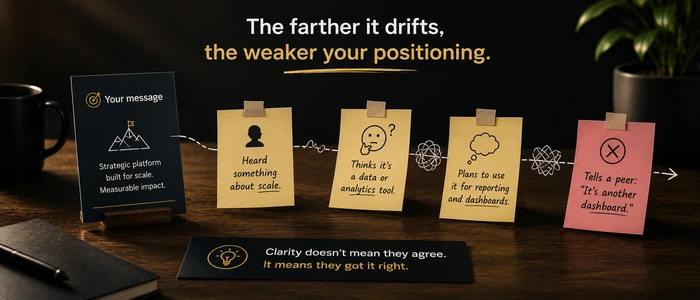
Follow a message after you release it. It moves from the website to a sales call, from the call to a champion, from the champion to finance, IT, procurement, or a department head who was never in the first meeting. At each handoff the listener compresses what they heard. People simplify, attach the new thing to the nearest thing they already know, and swap your words for words that feel safer to say out loud. None of this is malice. It is how memory behaves under load.
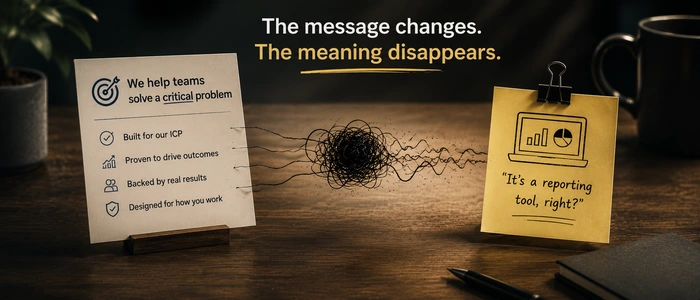
So the question is never whether the message will change. It will. The question is whether the important part survives the compression. "We connect insight, action, and measurable outcomes" compresses to "another reporting layer," because a familiar category is easier to carry than a new claim. "Built for how your teams actually work" compresses to "more change management," because the buyer maps it onto their last painful rollout. The team hears the smaller version and blames the buyer. The compression was predictable. The message was written as if it would never be compressed.
There is a hard commercial reason to care. Gartner's 2026 sales survey found 67% of B2B buyers prefer a rep-free experience. Gartner Discount the number as much as you like; what survives the discount is that for most of the buying process, nobody from your company is present. A message the buyer cannot repeat is not a weak message in those rooms. It is an absent one.
Why the internal review keeps missing this
Internal review asks inside-out questions. Are the words approved, is the category right, is every feature represented, does leadership like the ambition, does sales have the latest file. All of that can pass while the message still fails outside, because none of it simulates the one thing that happens next: someone else saying it, without you, under mild social risk.
That risk matters more than comprehension. A buyer can understand your explanation perfectly and still refuse to repeat it, because repeating it means staking a little of their own credibility on your words. Understanding is private. Advocacy is public. A message built only for understanding gets nodded at in the meeting and never spoken again.
"Clear" turns out to be a weak word here, because it hides the question that matters: clear to whom, under what conditions? Clear while you explain it is the easiest grade. Clear enough for someone else to repeat when you are not there is the grade the market actually gives. Most messaging review never gets past the first one.
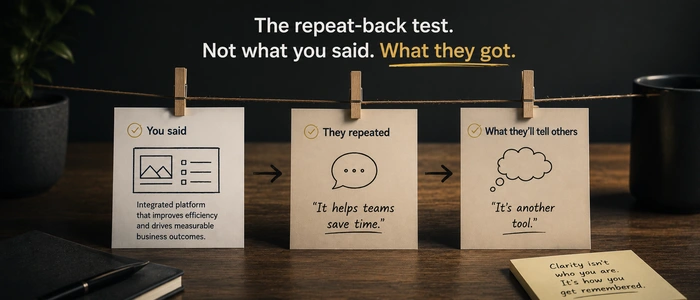
At CredFlow I watched this gap directly. The messaging that survived was never the most complete description of the product. It was the version a sales rep could say to a shop owner in one breath, and the shop owner could then say to a business partner that evening without notes. Completeness lost to carryability every single time.
The repeat-back test
The test is one conversation, and you can run it this week. Run it before you finalise anything the message will live in: a homepage, a sales deck, a product page, a launch narrative. It costs an hour and it is cheapest before the design work starts, because rewriting a sentence is free and rewriting an approved deck is a quarter of somebody's patience.
Take people close to real buyer conversations -- reps, customer success, solutions, support, a few friendly customers if you can get them. Do not start with the executives who approved the message; they will repeat it correctly and prove nothing. Walk each person through the positioning once, the way a buyer would meet it: the homepage read cold, or the pitch given once at normal speed. Then ask four questions, in this order.
- What do you think this product helps someone do? This separates outcome from interface. If the answer describes screens and features, the story is still product-first.
- Who do you think it is for? If the answer is broader or different than your intended buyer, the message is not selecting its reader.
- What would you tell another person after this call? This is the carry test itself -- not what they understood, but what they would risk saying. Expect it to be shorter and blunter than anything you wrote. That is fine. You are checking whether the value survives the shortening.
- What would make you believe it? If the answer is a proof point you already have but placed three clicks away, the claim and the evidence are separated, and separation reads as doubt.
Do not correct them while they answer. That is the hard part. Let the wrong version come out fully, and write it down word for word. The wrong version is evidence. The moment you interrupt to fix it, you are back to testing comprehension in your presence, which is the one condition the real world never provides.
Reading the answers
The answers sort into patterns, and each pattern names a different repair.
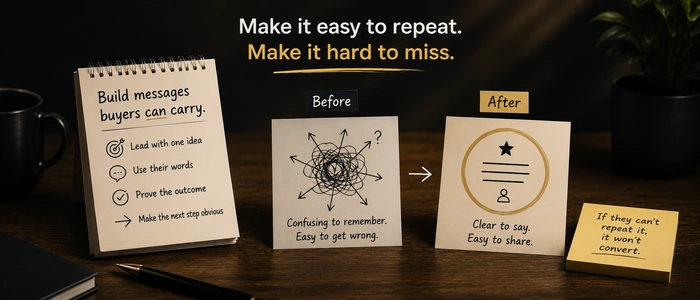
If five people repeat five different meanings, the problem is not word choice. The positioning is carrying too many possible stories, usually because the team was afraid to choose one, and each listener chose for them. Cut value props until one story is doing the work.
If everyone repeats the category and nobody repeats the value -- "it's a BI tool" -- the category has swallowed the message. The category was more familiar than your claim, so it won. Lead with the pressure the buyer feels, and let the category arrive second.
If everyone remembers a feature and nobody remembers the outcome, or everyone remembers the promise and immediately asks for proof, the fix is placement: move the outcome ahead of the mechanism, move the proof next to the claim it supports.
And if people can explain it, but only after three minutes of warm-up, the message is not usable in the wild. Nobody gets three minutes in their boss's doorway.
One caution before you rewrite anything: fix the pattern, never the individual phrase. If buyers keep calling the product a dashboard, the repair is not banning the word dashboard. The repair is asking why the interface is more memorable than the outcome. If they keep saying "it saves time," push on what time, for whom, in which workflow -- vague repeat-back is drift already underway. And if the answers come back clean and deals still stall, stop editing words altogether; the blocker is probably not the message.
The buyer is your distribution
Step back one level and the reason to run all this gets simpler. You do not control most of the conversations that decide a deal. The buyer does. The website, the deck, and the call are one story to the buyer, and if they disagree, the buyer does not average them into clarity -- they pick the simplest version and move on. Whichever version is simplest is the one that travels. That is why a deck that needs live translation fails the same test this article describes. It is also why an outdated version of your story, once loose, keeps travelling long after the launch -- shorthand does not expire just because you shipped new messaging.
I will not pretend the test controls the outcome. Buyers will use words you did not choose and would not approve, and some of the drift is permanent. The realistic goal is narrower and worth exactly this much: when the words change, the meaning survives.
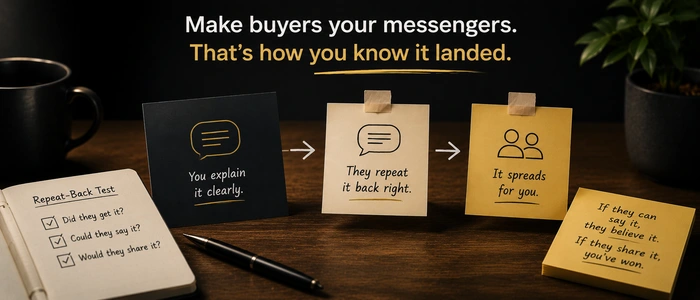
A buyer will always translate your message into their own language, and a healthy message survives that translation with the value intact. So before you call the positioning final, run the four questions and listen to what comes back. The company writes the message, but the buyer's retelling is the version that exists in the market. Your positioning has landed when that retelling still carries the meaning. Not before.