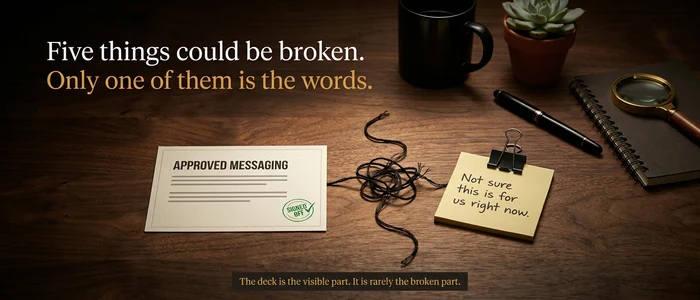
A deal goes quiet. The rep says the buyer did not get the value -- then someone forwards the thread to product marketing with one line on top: can we sharpen the messaging?
That request feels reasonable. It is also where wasted quarters begin.
I run product marketing across a seventeen-product portfolio, so that request finds me often. This article is the check I run before saying yes: a one-week diagnostic, built from evidence the company already owns, that tells you which of five failures stalled the deal. A message mostly fails because of decisions made somewhere else -- who it is for, what proof exists, what the product does -- and only one of those failures is fixed by better words.
I have taken that request many times and started rewriting immediately. New headline. New one-liner. New second slide. The deck comes back tighter. The next three calls go the same way as the last three. Nobody says anything, because the work looked like progress.
The message was never the thing that was broken.
The loudest problem is rarely the real one
Messaging gets blamed because messaging is the part everyone can see. Roadmaps are private. Pricing is sensitive. Sales process is somebody else's meeting. The deck is right there. On a screen. In front of a buyer who did not buy.
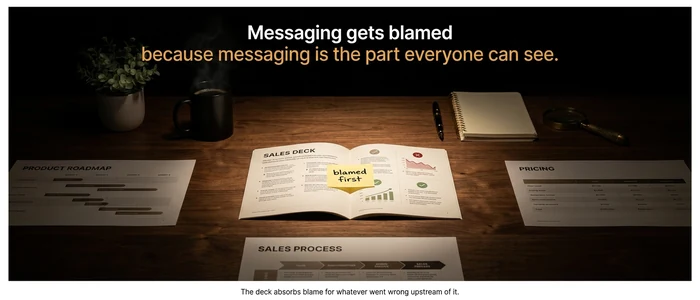
So the deck absorbs the blame for whatever went wrong upstream of it.
A rewrite is about a week of one person's time, and it ships fast, so it feels like the responsible answer. If the diagnosis underneath it is wrong, that surfaces six to eight weeks later, when the next deals stall in the same place. Then comes a second rewrite, and two rounds of that is a quarter gone, along with the pipeline sitting in the middle of it.
The diagnosis costs less than the second rewrite. That is the whole commercial case.
Five things the buyer could actually be reacting to
When a buyer does not move, one of these is usually underneath it. The number matters less than the habit of asking which one you are looking at.
The problem was not theirs
You described something real in the market. It was not the thing sitting on their desk this quarter. That is a targeting issue wearing a messaging costume.
They did not believe you solve it
The claim landed and the proof did not arrive near it, or the proof was a logo wall where a mechanism was needed.
They could not picture Monday
You described an outcome. They needed the workflow, and outcomes do not tell anyone what changes on their calendar.
They could not repeat it
They understood you fine. Then they had to explain it to finance, or IT, or someone with veto power who never met you. It came apart in transit. Check this one first: it is the cheapest to test, and the one that looks most like every other failure from the inside.
The product does not do it
Rare. Expensive. Everything held until the demo.
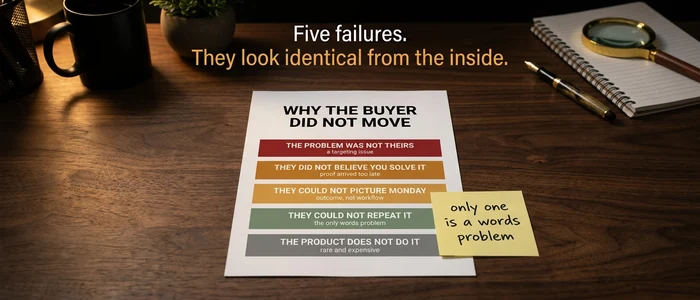
I would rather find out which of the five it is than write five versions of a headline and hope.
The stall check
The five need a way to map evidence onto them. What a buyer does next is the cleanest signal there is, because it happens without being asked for.
- Engaged well, then said the timing is wrong. The problem was not theirs.
- Asked who else uses this, or how it works underneath. They did not believe it solves it.
- Asked for another demo. They could not picture Monday.
- Asked for something they could forward internally. They could not repeat it.
- Reached the demo and went cold there. The product does not do it.
Run it across the last ten stalled deals rather than one. A single deal is a story; ten is a pattern, and the pattern shows where the money is going.
The middle two -- could not picture Monday and could not repeat it -- blur in practice. Someone who cannot picture Monday usually cannot retell it either. The tiebreaker is what they ask for next. A request for another demo means the workflow is missing. A request for something they can forward means the words are.
Usually two of these are running at once. Fix the cheapest one first and re-test; fixing two together reveals nothing about which one mattered.
The evidence you already have
Before touching the deck, I would go find three things. None of it needs a research budget, and none of it needs anyone's approval.
Call it four to six hours of actual work, spread across a week, because live calls have to happen on their own schedule. It is still cheaper than one rewrite.
Read the last ten lost-deal notes. Not the reason codes, which are usually chosen from a dropdown by a rep in a hurry. Read what they actually typed in the free-text box. Reps write the truth there because nobody is grading it.
Then sit on two calls. Not recordings at 2x speed. Live, with the sound of the pause in it. Watch the exact moment the rep stops using the deck and starts explaining in their own words. Write down the sentence they use instead. That sentence is data. It is the version that survives contact.
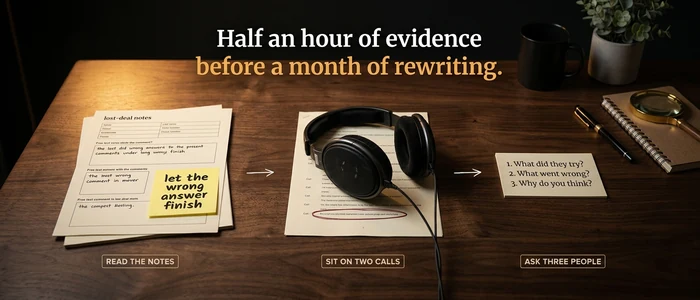
Then ask three people who were on those calls a single question. In your words, what does this product help someone do? Do not correct them. Let the wrong answer finish.
Three different answers means the message is holding too many possible stories, and no amount of rewriting one headline fixes that. The same answer, but smaller than what the product does, means the message is under-claiming. The right answer, with deals still stalling, means the problem is somewhere else entirely.
The room you are not in
The fourth failure is, I think, the one teams underestimate most, because it happens after the call ends.
Wispr Flow is a voice dictation product that reached 270 of the Fortune 500 and 2.5 million downloads before raising $25M from Notable Capital, as TechCrunch reported in November 2025. Their founder described the enterprise motion on Think School himself. Wispr grew through individuals adopting it first and converting those pockets into company-wide deals, so its enterprise path arrives late; the part that generalises is what happens once it does.
Getting into a company means IT approves it. Security reviews it. Legal signs it. The person who first liked the product presents to all of them. Nobody from the vendor is in the room.
That is the repeat problem in practice. The champion becomes the messenger, and whatever they cannot carry accurately gets lost or invented. A security lead does not hear your positioning. They hear a summary of a summary from a colleague who had one demo, delivered to a room that cannot agree.
His framing of the sales job -- work out the buyer's problem instead of selling a product -- reads as an instruction about the message: build it so a non-expert can defend it in a room full of people whose objections you have never heard.
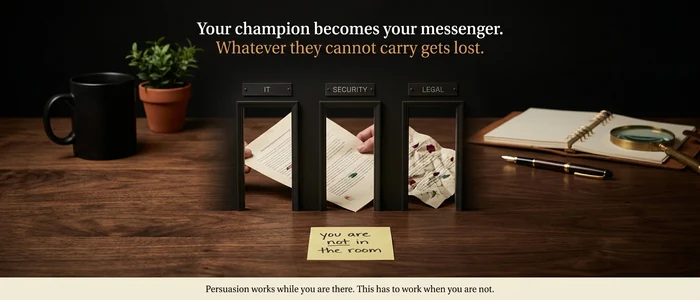
Persuasion works in the room. This has to work outside it.
Gartner's buyer research keeps landing on the same point: most B2B buyers would rather move the decision forward without a rep in the room at all. Gartner The message spends more of its life unaccompanied than most teams plan for.
Buyers going quiet after a good first call is the signal for this one, and the repeat-back test is the cheapest way to find out whether your message survives the journey.
What each finding actually asks you to do
If the problem is segmentation, the work is in the target list and the qualifying questions, and product marketing owns that with sales leadership. Rewriting copy only makes the wrong buyers reject the pitch more articulately.
If the problem is proof, the work is finding one customer willing to describe the mechanism on record. A deck full of approved claims and no usable evidence is a different failure than an ugly deck.
If the problem is that nobody can picture Monday, the work is a workflow walkthrough, not a value proposition. Sometimes that is a thirty second screen recording.
If the problem is that the message does not survive being repeated, the work is compression. One idea, buyer language, proof next to the claim, obvious next step. This is the one failure where the request that arrived was correct.
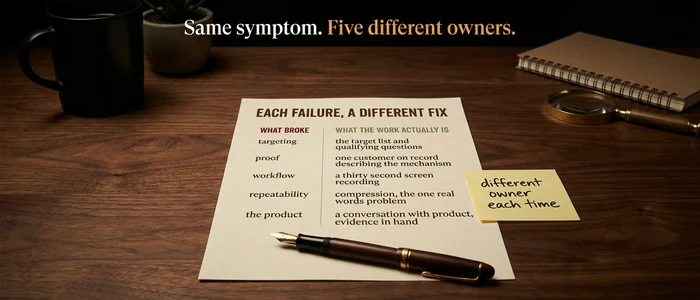
If the problem is the product, the work is a conversation with product, and it is easier to have with ten lost-deal notes than with an opinion.
The costs are not close to each other. Targeting is a change to a list. Proof is a customer marketing project measured in weeks. A walkthrough is an afternoon. A product gap is a roadmap conversation and a quarter at least. Picking the wrong one spends the wrong budget and leaves the actual cause running the whole time.
Do the cheap check first
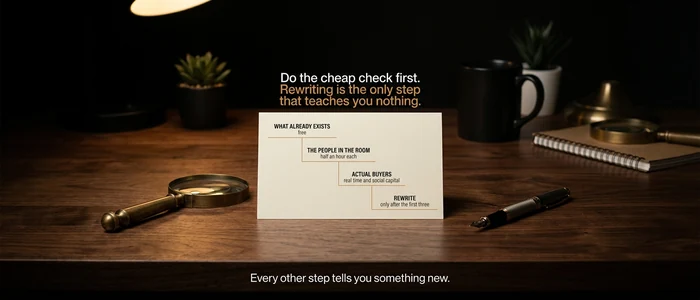
The order is mostly about cost.
Start with what already exists. Lost-deal notes, call recordings, the questions that keep coming up in the support inbox. Free to read. Nobody has to agree to anything.
Then go to the people who were in the room. Reps, solutions engineers, whoever ran the demo. Half an hour each. Still cheap.
Then talk to buyers. This costs real time and social capital, so it comes after the question is already sharp.
Rewriting comes last. It is the only step that teaches nothing. Every other step returns something new. Writing simply commits the team to whatever it already believed.
I have inverted this order plenty of times, usually when someone senior asked for the deck by Thursday. The deck arrives on Thursday and the problem arrives again in March.
Why this keeps happening
The request arrives as a task because tasks are easy to send. Sharpen the messaging is four words. Investigate why five deals stalled is a project, and projects need someone to agree to them. This is the same pressure that turns product marketing into a request desk.
Accepting the task version feels helpful, and pushing back sounds like avoiding work. I have done this plenty; it is faster in the moment and slower over the quarter.
The useful move does not ask for permission. Agree to the deadline first. Then make the deliverable conditional on ten minutes of thinking that the other person now has to do with you. Something close to this works: you will have it Thursday, and before I start, which of these did we actually see. Then name the five.
Nothing has been refused, and the conversation has moved from what to make to what happened. Most of the time the person has the answer and it takes two minutes. Sometimes there is a silence, and the silence is the most useful thing all week: the request was a guess, and now both people know it.
A good answer to the wrong question still leaves you with the wrong question.
When nobody has a week
Plenty of teams cannot spend four to six hours on this -- one marketer, three launches, a board on Thursday. Run the cheapest check alone: the last ten lost-deal notes, under an hour, nobody's permission. If they point at one thing, act on it. If they point at five different things, the message is carrying too many stories, and that is itself the finding. Either way it beats rewriting on a guess.
When to skip all of this
Sometimes the deck is simply bad and you should fix it this afternoon.
If the message has never met a buyer, rewrite; there is nothing to diagnose yet. If the stakes are small, rewrite; a conference abstract does not need a research project. If deals are closing and nobody is complaining, change whatever is annoying and move on.
The diagnosis earns its cost in one situation: deals are stalling in a pattern, and nobody in the room can say why. If someone can say why, and they are right, act on it.
A method you run on everything is not judgement. It is a habit.
The part worth keeping
A message is a compression of decisions that were made somewhere else. Who this is for, what it replaces, what proof exists, what happens after they say yes. When those decisions are clear, writing the message takes an afternoon. When they are not, no amount of writing will hold, because the words are being asked to do work that words cannot do.
So when the request comes in, do not start with the sentence. Start by finding out which of the five things actually happened. If it helps to have the questions written down, the clarity worksheet covers the same ground in a page.
The rewrite is usually the last step, and it is usually the easy one. Getting to the point where the rewrite is obvious is the actual work, and it is the part that protects the pipeline sitting behind it.