
An AI assistant now writes the follow-up email after every sales call. The drafts read well. Reps send them barely edited, the pipeline dashboard looks calm, and nobody in the building would call the rollout a failure.
The uncomfortable part sits upstream of those drafts, in what the tool was allowed to read before it wrote them. It has been reading the launch-deck explanation that sounded fine in review and collapsed the first time a buyer asked what the product replaces. The approved value prop nobody actually says on calls. A proof point nobody has checked since the screenshot was taken. The tool cleaned none of that. It made all of it fluent.
So here is the claim, flat: a GTM tool inherits the company's commercial memory as it actually is, unresolved decisions included. AI does not resolve what it reads; it makes what it reads fluent, and fluent sounds settled. The useful move before automating more go-to-market work is an audit of what the tool will inherit, and the last section of this article is that audit -- five documents, three questions, one afternoon.
Seventeen products, one product marketer: that is my situation, so the memory an AI tool would inherit here is mostly material I wrote, or material I never finished deciding. I know these documents from the inside.
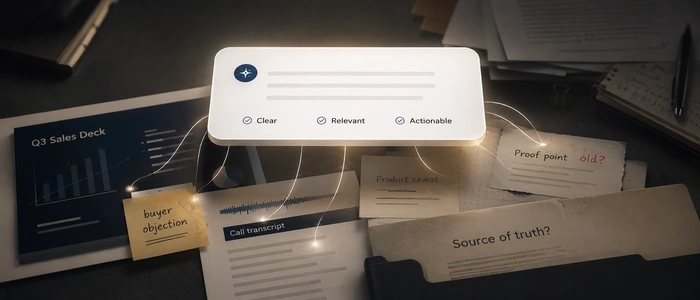
The tool arrives before the questions
Most teams do not skip the inspection because they are careless. They skip it because the tool gives them motion on day one. Sales wants follow-ups without writing them. Marketing wants six variants by Friday. Enablement wants an answer bot so reps stop pinging the one person who can explain the product properly. Every one of those wants is reasonable, and the tool meets them all in its first week, which is exactly why nobody asks what it has been reading.
For a while it feels like relief. The rep gets an account summary. The manager gets a call recap without sitting through the recording. Then a buyer replies to a fluent follow-up asking about a capability that was cut two roadmaps ago, and the team meets the reading list for the first time. The assumption underneath the rollout was that AI can make GTM clarity out of GTM clutter. It cannot. It can only make the clutter easier to send.
GTM memory debt
GTM memory debt is the pile of commercial decisions a company never finished making, stored as documents that disagree with each other. It accumulates the ordinary way. Every deck, battlecard, and case study was written by somebody, at a moment, for a purpose, and each one froze whatever the company believed that week. The product moved on. The documents did not. Nobody deletes an old answer; people write a new one beside it. Ten quarters of that, and the shared drive holds four descriptions of the buyer, three value stories, and proof points of different ages, all formatted as if they were current. The flagship case study still quotes a customer who churned last year, and nobody remembers which report its number came from.
Before AI, the debt at least slowed people down. You had to open the folder, notice the disagreement, and ask somebody who knew. With AI on top, the debt becomes searchable, and searchable feels settled. A knowledge base is not automatically a source of truth because it has a search bar. Sometimes it is just a better-lit storage room for unresolved decisions.
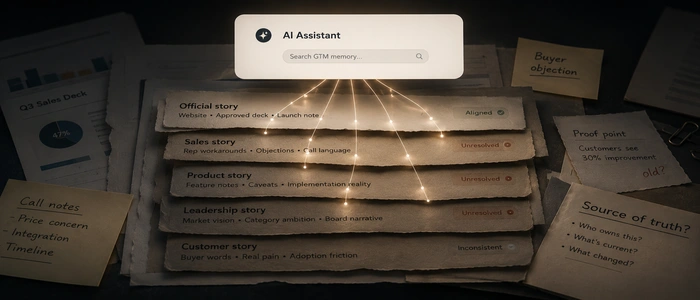
Watch it happen on one email. A rep asks the assistant to summarise the product for a procurement contact. The retrieval finds the launch deck from two years ago, the current product page, and a battlecard carrying a competitor's old pricing. All three sit in the index, and none is marked as expired. The summary blends them into confident prose, and the rep, with thirty seconds between calls, hits send. The launch ended long ago, but the old story is still on file -- and now it has a distribution channel.
Nobody owns the shelves
Go one level up, because this is an incentives problem before it is a tooling problem. Every one of those documents had an owner on the day it was made; a launch, a campaign, or a deal needed it. Almost none of them has an owner today. Maintenance produces no launch and no number, so nobody gets credit for retiring an old answer, and commercial memory rots by default. The org chart pays for new answers and pays nothing for expiring old ones.
So the ownership question comes before the tool question. Somebody has to own who the buyer is, described without persona labels. Somebody has to own the message, meaning the value logic sales and marketing both carry, tested by whether a buyer can repeat it back. Somebody has to own proof: which claims have evidence, which evidence has a date, which claims have quietly expired. And somebody has to own where each document actually gets used, because a homepage sentence and a call-prep note can safely hold different standards. Where those four disagree, the disagreement is a decision waiting for an owner, and rewriting the words will not settle it.
I keep a one-line answer for each of the four against every product I cover. The lines I cannot fill are the products where I trust the tool least, and they are the first ones I pull out of any automation.
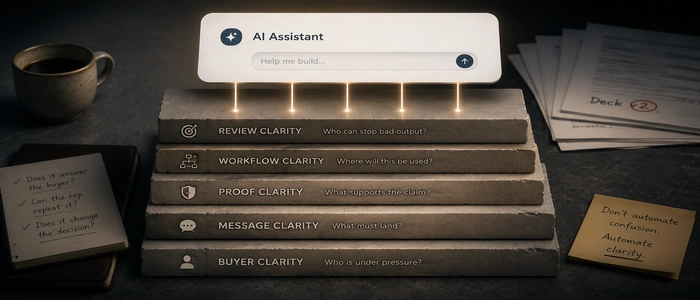
The line the tool cannot cross
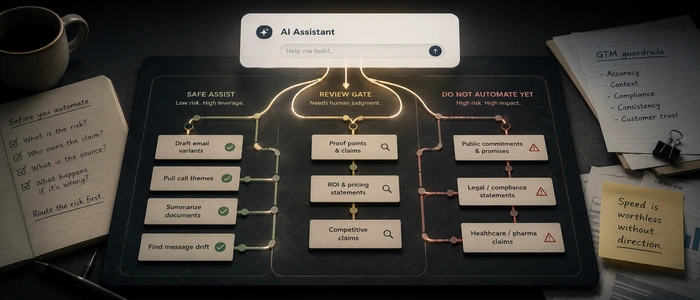
There is a line worth drawing before the next tool goes in. AI can compress the work around a decision you have made. It cannot make the decision, because deciding what the product means to the buyer is a choice between real alternatives, and the choice costs something a model does not have to pay.
Ask it for the first draft anyway and it will oblige, which is the trap. Its genuine strengths sit one level down: it organises, compares, and finds the five call notes that raise the same objection. It shrinks repeated work around material the team already understands. Asked to invent the understanding, it produces fluency instead, and fluency reads as decidedness. A weak claim, phrased well, starts to sound agreed-upon.
Nielsen Norman Group's guidance on product-specific genAI content asks of the machine what editors ask of people: clarity, concision, plain language, structure a reader can scan. Nielsen Norman Group A tool can clear that bar and still be wrong about the product, because the bar measures the writing and the debt lives in the inputs. Awkward output announces itself. Finished-sounding output nobody has thought through is the expensive kind.
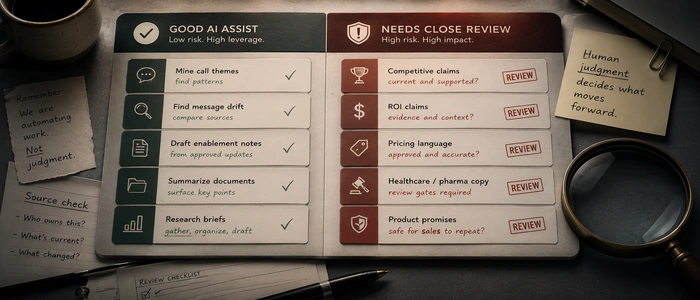
The audit comes before the automation
The first AI question most GTM teams ask is "what can we automate?" That question creates bad automation quickly, because almost everything can be automated badly. The better first question: what must this workflow never get wrong? A follow-up must never promise a capability. A competitive asset must never carry stale pricing. A renewal summary must never soften a risk somebody flagged.
Ask that question per workflow and every answer points backwards. Each "never" lives inside a document the tool will inherit -- the deck, the battlecard, the call notes. That is why the audit comes before the automation: automation spreads whatever the audit would have caught, at the speed of the tool. And the deck that looks finished is the usual hiding place.
The five-document audit
The audit is deliberately small. Pull five things: the sales deck reps actually present, the product page, the battlecard, the most recent campaign brief, and notes from five recent sales calls. Lay them side by side and ask three questions.
- Do they describe the same buyer? The same person, under the same pressure, trying to fix the same problem -- persona labels do not count as agreement. Four documents describing four buyers means the company has not chosen, and the tool will sample from all four.
- Does the proof match the claims? Trace every "faster", "safer", and "trusted by" to its evidence and its date. A claim whose evidence has expired is debt collecting interest, and it compounds every time the tool repeats it.
- Does each document have a named owner who updates it when the product changes? A blank against that question marks where the debt comes from, and where it will come from again after you clean it once.
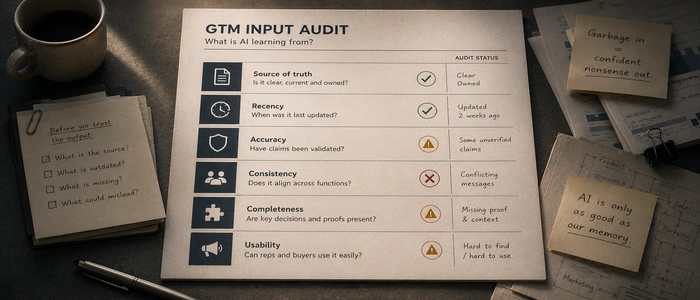
Expect the call notes to disagree with the other four documents, because reps write down what actually worked in the room. Treat that as the finding rather than as noise. The improvised sentence that keeps closing deals is the closest thing to a decided story the company has, and it is sitting in a text field nobody indexes on purpose.
End to end, the audit is an afternoon, and I think it teaches more than a quarter of prompt tuning would. If the five documents agree, automate with a clear conscience; the tool inherits a decided story. If they disagree, you have found the real work, and it is not prompt work. Settle the disagreements, date the proof, put a name against each pile, and then let the tool make the settled version fast. Guarding the outputs on the way out is its own discipline, downstream of this one.
The tool is working; that was never in doubt. What it works from is the decision you still own. Make the memory something you would sign.