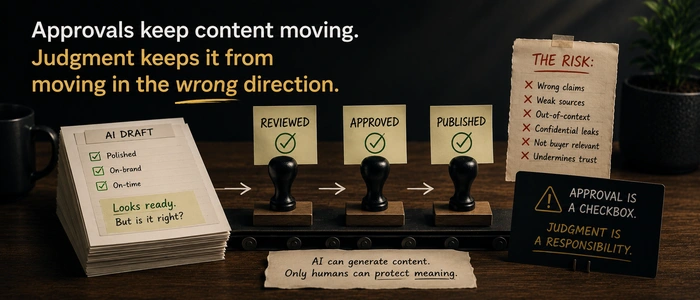
The AI draft is clean. The headline is neat, the intro sounds confident, and the product terms are correct enough that nobody panics. So it moves. A content lead skims it, a PMM checks the product line, legal scans for scary claims, someone asks whether the CTA could be stronger, someone else types "looks good to me," and it ships.
Approval carried it farther than judgment did.
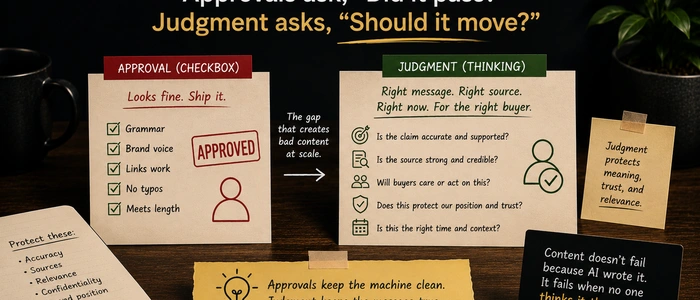
Those are two different mechanisms, so pin them down before anything else. Approval is a workflow event: a person decides the draft can move to the next step. Judgment is a standard: a person decides the draft deserves to exist and can be defended when a buyer, a rep, or a regulator leans on it. A workflow can be full of approvals and contain no judgment at all. Approval asks, "Can this go out?" Judgment asks, "Should this exist, and can we defend it?"
I do product marketing as a one-person function for seventeen products, and I publish this knowledge base with AI doing real work in the drafting. So I live on both sides of this problem: I want the speed, and I am the person who has to defend whatever ships.
What follows is the structure that closes the gap for me -- a judgment layer with three parts. Every reviewer protects one named thing. One person holds the authority to kill a draft. And the weight of the review matches the risk of the claim.
The weak draft stopped announcing itself
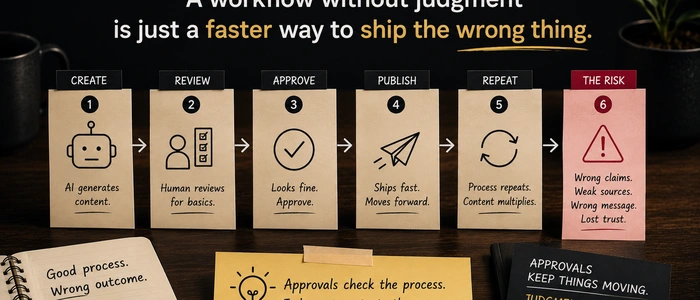
Review processes were built on an assumption that used to hold: surface damage predicts substance damage. Before AI, weak work confessed on its surface -- thin structure, clumsy sentences, a missing section. A reviewer could catch the problem in a skim because the problem was visible in the prose.
AI broke that correlation. The weak draft does not always look weak anymore. It arrives fluent, organized, and safely generic, and it passes review because nothing is obviously broken. "Nothing is obviously broken" is a very low bar for a product page, a launch post, or anything a buyer will read. The failure has a slide version too: a sales deck can be beautiful and still fail in use.
You have seen the draft I mean. A launch post with tidy sections and one load-bearing claim -- "cuts onboarding time" -- resting on a customer quote about how responsive the support team is. The claim is plausible. The quote is real. The connection between them does not exist, and no box on the approval form asks about it. A person would have taken two days to write that draft. The tool took forty seconds, which means the next one is already in the queue behind it.
This is also why "was it written by AI" is the smaller question. Google's guidance says as much: using AI is acceptable in itself, and the spam label is reserved for automation aimed mainly at manipulating rankings. Google Search Central, 2023 The standard that matters is whether a reader can rely on the thing, and that standard is exactly what an approval stamp does not measure.
Give every reviewer one named thing to protect
"Please review" is the weakest sentence in the workflow. It is the reviewer's version of "can you quickly make this": a request with no defined outcome, sent to a busy person. A reviewer handed "please review" checks whatever they already know how to see. Brand checks tone. Legal checks exposure. SEO checks structure. Each pass is valid, and the sum of valid passes still skips the question that matters -- is this true, specific, and worth publishing? -- because that question was assigned to nobody.
The fix costs one sentence per reviewer. Name the thing each person is protecting, inside the request itself.
- For the PMM: is every product claim here something a rep could say out loud on a call without wincing? - For legal: which sentence would you refuse to defend, and what has to change so you would? - For the source check: does the evidence support this exact claim, and does it come from a source you would bet on? - For the editor: what does this say that a generic post on the same topic would not?
The editor's question is the one I run hardest on my own site: if a paragraph could appear unchanged on a generic SaaS blog, it gets rewritten or cut. A reviewer with one named thing reads differently. They stop skimming for typos and start hunting for the single failure they own, and they can be held to it afterwards, which "please review" never allows.
Put the kill in one person's hands
The drafts that need killing are rarely the broken ones. They are the accurate, sourced, on-brand drafts that say nothing. Every reviewer approves, because the thing each of them protects is intact, and emptiness sits in nobody's lane. Without one named person who can stop a draft for being pointless, "fine" ships -- and fine is what AI produces at volume.
The kill has to be a person, never a meeting. A meeting dilutes the decision back into approvals: five people each holding a fifth of a no. The person needs standing to say "this is fine, and fine is not enough" without producing a rubric to justify it, because the empty draft passes every rubric the team knows how to write.
So the last review decides existence: does this deserve to be published at all? One person holds that decision. A good editorial process needs a kill switch. On this site the kill is mine, and the hardest drafts to kill are the competent ones, because killing competent work looks like waste. The real waste is publishing it; every interchangeable page teaches your reader to skim you.
The kill also gets easier the earlier the question is asked. Deciding whether the asset should exist is a cheaper conversation before anyone writes it than after five people have approved it.
Match the gate to the risk
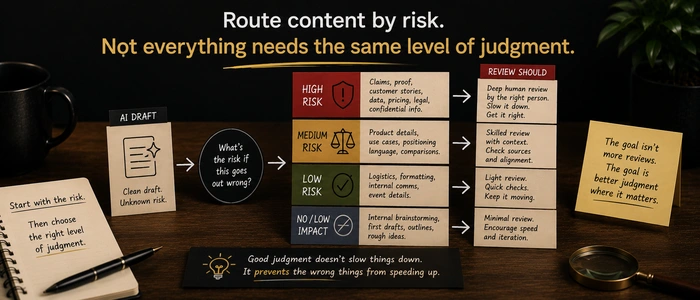
The third part protects reviewer attention, which is the scarcest input in the whole system. If every output gets the same review, people ration invisibly: they learn to skim the gates on trivial work, and the skim becomes a habit that follows them into the gates that matter. Sorting by risk is what keeps the heavy reviews honest.
The sorting question is short: if this is wrong, what does it cost, and who ends up holding it? A wrong sentence in an internal recap costs a correction in a Slack thread. A wrong number in a customer-facing deck follows a rep into a demo and gets repeated to a buying committee. A wrong claim on a public page costs the most, because the old story keeps travelling after you fix the page -- it gets cached, quoted, and read for quarters.
So weight the reviews accordingly. The recap gets a skim. The deck gets one named reviewer. The public claim gets the full layer, ending at the kill question. Heavy review on everything is how teams talk themselves out of review on anything.
Proof has to do a job
One failure deserves its own section, because it is the one judgment catches and approval misses most often. Proof is not decoration. Proof has to do a job, and the job is supporting the exact claim standing next to it.
The mismatch survives review because both halves look fine alone. "Improves efficiency" is a reasonable claim; a quote praising ease of use is a genuine quote. Put them together and the evidence does not carry the sentence. AI makes that pairing constantly and confidently, because the claim and the quote share a topic, and topical fit is the thing the model is best at.
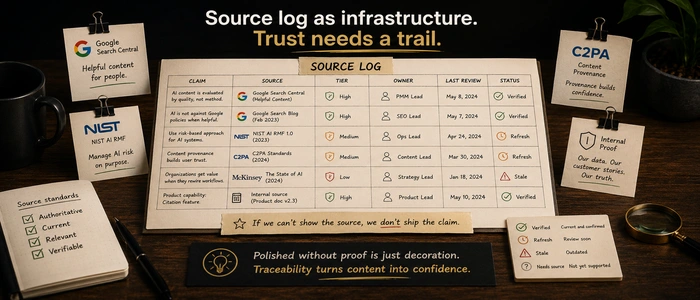
The reviewer instruction is mechanical: read the claim, read the proof beside it, and ask whether a skeptic would accept the second as evidence for the first. Then keep the trail. For every number and named result on my site, I log where it came from and when I last checked it, because a claim gets reused months later by someone who never saw its source, and the log is what stops an expired number from getting a second life.
Monday, on one workflow
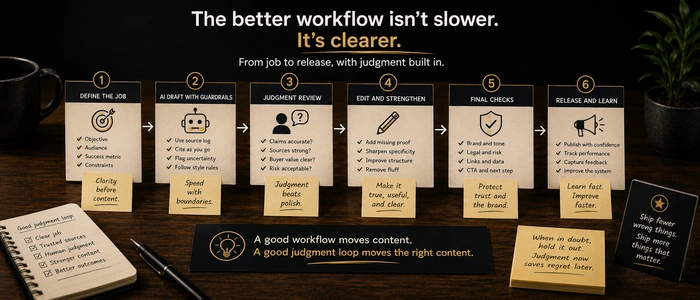
Do not start with a governance document. Pick the single content workflow that already matters most -- for most teams, the product page or the launch post -- and install the layer there. Three moves, in order.
- Write one sentence per reviewer naming the thing they protect, and send it with every draft. That sentence is the brief, and it is the reason the review returns something a checkbox cannot.
- Name the person who holds the kill, out loud, before the next draft exists. An unannounced kill switch is a fight scheduled for launch week.
- Sort the workflow's outputs by what a wrong claim would cost, and spend the heavy review only where the cost is. That is what makes the layer affordable enough to survive.
Then look upstream once, because review is the second half of the problem: the material the tool was given to work from decides what the drafts contain before any reviewer opens them.
That is the whole change, and I think it is smaller than it sounds. Approval decides whether content can move. Judgment decides whether it should exist and whether you can defend it. AI has made moving cheap. Judgment is the part you still have to build.